
iTechGuides is reader-supported. When you buy through links on our site, we may earn an affiliate commission. As an Amazon Associate I earn from qualifying purchases. Learn more
“Paper battery” can mean very different things. One research design used algae-derived cellulose coated with a conducting polymer to make a thin battery electrode; another printed living cyanobacteria onto paper to harvest a small electrical current. Both are laboratory prototypes, not established consumer products—and the cyanobacteria device is closer to a tiny bio-solar panel than a conventional rechargeable battery.
What does “paper battery” mean?
Paper-based energy devices are not one chemistry or product category. Depending on the design, paper can serve as an electrode, a structural support, a separator, or a reservoir for electrolyte. Some designs store and release charge like batteries; others generate electricity from biological activity. Their performance figures are not necessarily comparable: a battery’s charge current or cycle life is different from a device’s power output per area.
Two often-associated technologies illustrate the distinction: an all-polymer battery electrode made using cellulose fibers of algal origin, and a biophotovoltaic cell printed with living cyanobacteria.
Free tools Windows power users keep installed
One-click scans. No signup required.
How the algal-cellulose paper battery works
In a 2009 study, researchers used cellulose fibers of algal origin, identified in the relevant context as coming from Cladophora algae. They coated the fibers with a 50-nanometer layer of polypyrrole, a conducting polymer. The porous cellulose gives the material a large surface area, while the polymer coating makes the paper conductive. The result was an all-polymer paper-based battery electrode—not a battery containing living algae. The authors’ 2009 Nano Letters paper reports a specific surface area of 80 m²/g.
#1 Best Overall

- Fruit Battery Kit: Comes with 5 x copper sheet, 5 x zinc sheet,1 x electronic clock, 2 x RGB LED,1 x RED LED, 5 x wires, 2 x wires with clip,1 x buzzer sounder, 1 x propeller fan, 1 x dc motor, 1 x instruction, good kit for your kids DIY STEM science project
- Fruit Science Kits for Children: The product fan with a faster motor represents a stronger voltage, which can cultivate children's observation ability. The different bright lights and the sound level of the buzzer are also suitable for classroom scientific power generation experiments
- Fruit Battery Application: Through interesting fruit battery scientific experiments, parents can accompany your children to play and cultivate their science learning interest. Improve children's ability to do things on their own, develop children's imagination and creativity
- Easy to Operate: It is easy to use in scientific projects. Before experiment , you only need to prepare lemons, apples or some vegetables and beverages to assemble the battery. We provide simple experimental ideas. Please kindly see the circuit combination on our pictures and avoid short circuit
- Warm Notice: Suitable for 8+ years. Be careful of scald caused by short circuit. Do not mix old and new batteries. Do not mix alkaline, standard (carbon-zinc), or rechargeable batteries, the kids must use under the supervision of adults
In the prototype study, the authors reported a charging current of up to 600 mA/cm² and 6% capacity loss after 100 charge-discharge cycles. These are measurements for their research device, not specifications for a product available to buy or a guarantee of performance in other designs.
How the living-cyanobacteria paper device works
A separate 2017 design was a biophotovoltaic (BPV) cell. Researchers digitally printed cyanobacteria onto a carbon-nanotube conducting surface on paper. A hydrogel supplied water and a small amount of growth medium while providing an ionic bridge. In light, photosynthesis supports electrical current; after the light is removed, biological compounds stored by the cells can support current for a time.
Rank #2

- Package Includes: 4 pieces copper sheet, 4 pieces zinc sheet,1 piece Electronic clock,2 pieces RGB LED,4 pieces Wire, 2 pieces wires with clip, 1 piece English assembly instructions
- Easy to operate: you only need to prepare fruits, vegetables or drinks to assemble a battery to work with led or electronic watches, such as: apples, oranges, potatoes, lemons, tomatoes, cola, pears, pineapples, or salt solutions, etc.
- By completing the Fruit battery Science Experiment Project with student, let student experience the mystery of science, develop theirs imagination and hands-on ability, and make them more interested in scientific experiments.
- Read the instructions carefully before building the project to avoid damage to the electronic watch or to prevent the LED from working.
- Fruit selection:we suggest you use fruit with more juice, tomato will be your first choice, if you choose lemon and orange, please insert copper and zinc tablets in the same petal flesh (there is a membrane between the different petals that will hinder the transfer of electrons), as far as possible, insert copper and zinc tablets all the way into the fruit.The LED lighting effect is more visible in dim environments.
The 2017 Nature Communications study reported areal power output of 0.38 mW/m² in light and 0.22 mW/m² in darkness. The authors reported sustained output for more than 100 hours under light-dark cycling. They demonstrated a small digital clock and an LED flash using multiple modules. Those demonstrations show what a low-power biological device can do; they do not show that it can replace a household battery or run everyday consumer electronics.
The Tool Desk
Outbyte PC Repair FREERepair Windows errors before they cause bigger problemsFix Now →Outbyte Driver Updater FREEScan for outdated or missing drivers - takes under a minuteDriver Scan →How the two approaches compare
| Feature | Algal-cellulose polymer electrode | Printed cyanobacteria BPV cell |
|---|---|---|
| What algae contribute | Cellulose fibers of algal origin form the porous material; the electrode is coated with polypyrrole. | Living cyanobacteria generate current through biological activity. |
| Role of paper or fibers | Algal cellulose is the high-surface-area structure coated with conducting polymer. | Paper supports the printed cell and conducting surface. |
| Energy behavior | Battery-electrode design intended to charge and discharge. | Biological current generation, supported by photosynthesis in light and stored compounds for a time in darkness. |
| Reported performance | 80 m²/g specific surface area; charging current up to 600 mA/cm²; 6% capacity loss over 100 cycles, as reported by the 2009 study. | 0.38 mW/m² in light and 0.22 mW/m² in darkness; more than 100 hours of output under light-dark cycling, as reported by the 2017 study. |
| Demonstration | Electrode and charge-discharge measurements in a research study. | A small digital clock and an LED flash powered using multiple modules. |
The figures describe different measurements and devices, so they are not a head-to-head test. A broader review discusses paper-based metal-air batteries, lithium-ion batteries, and supercapacitors as further, distinct configurations, and notes that commercialization remains challenging. The 2022 review is useful field context, not evidence that these prototypes are interchangeable.
Rank #3

- 6 COMPLETE FRUIT BATTERY STEM KITS: Includes 6 individual science kits with copper/zinc plates, electronic clock, RGB LEDs, wires, clips & clear instructions. No extra tools required, allowing kids aged 6-8 8-12 to finish DIY assembly easily with clear graphic steps, perfect for beginner STEM projects
- LEARN THROUGH PLAY: Transforms abstract concepts like circuits and conductivity into tangible experiments. Great stem projects for kids ages 8-12 that develop problem-solving and engineering thinking
- PERFECT FOR GROUPS & CLASSROOMS: Available in 6-pack bulk quantity, these bulk STEM kits and school supplies are perfect for classroom group learning, school science fairs, summer camps, kids science party favors and home learning activities. Easy to hand out, easy to enjoy
- SAFE & DURABLE: Made from high-quality, non-toxic materials – safe for kids and built to last through multiple experiments. Safe stem kits for kids age 6-8 8-10 10-12
- GREAT GIFT FOR YOUNG SCIENTISTS: These STEM toys for ages 8-13 are perfect for birthdays, holidays, classroom rewards, or summer camp. Plus, building and experimenting together makes for a wonderful screen-free family activity that parents and kids can enjoy side by side while exploring the wonders of science!
What newer seaweed-paper research adds
A 2023 seaweed-paper battery study reports biodegradability and toxicity tests. Its abstract also says the authors found 58% lower weight and 16.7% higher voltage capacity than the comparison they used. Those are the authors’ stated comparison claims; the abstract does not provide enough methodological detail to generalize them to paper batteries as a category. The study’s abstract does not establish a commercially available product.
Algae-derived materials may offer renewable or waste-resource pathways, but feedstock alone does not establish that a battery is sustainable. Sourcing, processing, the other materials in the device, durability, and end-of-life handling all matter. Nor does the use of paper mean that every paper-based battery is biodegradable; that requires evidence for the specific design and its disposal conditions.
Rank #4
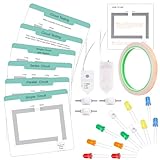
- Safe & Simple Circuit Kit: Our paper circuit kit is designed with children's safety in mind. The electric circuit kit for kids uses copper tape to create circuits, and the button battery is securely housed in a screw-fixed battery box, preventing accidental swallowing. With low voltage and current, this circuit kit ensures a high level of safety, making it a great STEM toy for young explorers
- All-In-One Exploration Kit: No soldering or tools needed! Includes circuit cards, LED diodes, copper foil tape, button coin cell battery holders and button switches. Simply use copper tape to create conductive pathways, install the LED bulbs to bring the circuit to life, and then connect the circuit to the wires of the battery case. Sparks curiosity in DIY engineering projects and science experiments for kids
- Science Learning Through Play: Make learning a joyful experience! Each card in the kit features a different circuit concept, from series and parallel circuits to switches. Come with clear instructions and engaging questions, great for kids aged 8 and above science learning beginners to explore electronic components and to understand the fundamental electrical principles
- Encourage STEM Skills: STEM is most important for each kids. Our paper circuit experiment kit encourages critical thinking, problem-solving, and logical reasoning. It's an excellent tool for homeschooling, classroom activities, or simply quality family time, fostering kids’ STEM skills
- Educational Gift for Kids 8-12: This electric circuit kit is design for the kids starter who want to explore the science or engineer, follow our instructions, children can easy get the STEM skills. It’s a great gift for Easter, birthday, or back to school day. You can play in home, classroom, or family bonding, making science fun now!
What could these devices be used for?
The printed cyanobacteria prototype’s very low reported areal power points toward low-power sensing and short-duration sensing applications, rather than replacing batteries in phones, laptops, or vehicles. The authors themselves identify performance and scale-up improvements as necessary. The algal-cellulose electrode demonstrates a different possibility—using porous, algae-derived cellulose in a charge-storage design—but the reported prototype measurements do not establish a finished application or retail specification.
Recommended Free Tools
Are paper-and-algae batteries commercially available?
The cited studies describe research prototypes, and the reviews discuss barriers to commercial integration. The sources cited here do not verify a consumer product or retail availability. Treat claims about a “paper battery” as incomplete until they identify the device’s chemistry, what role paper plays, what has actually been demonstrated, and whether the claim concerns a laboratory result or a purchasable product.
Quick Recap
Best Value

- POTATO BATTERY KIT - This STEM science kit teaches kids about electricity with the components they need to build a DIY potato clock with voltmeter. Easy-to-follow instructions let kids get started right away, all they need is two potatoes!
- COIN POWERED FLASHLIGHT - The science experiments for kids in this kit continue with an amazing penny flashlight. Kids will construct a battery with the included "coins" and see the electric circuit come to life when they turn on the flashlight.
- ASTOUNDING SCIENCE EXPERIMENTS - This combination of STEM labs give kids the chance to learn about electrical engineering in a fun, hands-on, and memorable way. This is a great science gift for any curious kid that loves to build and explore!
- SO MUCH TO LEARN - Not only will kids make a battery and a complete electrical circuit, they'll also learn why these things work. Our detailed learning guide provides fascinating insight into the science of electricity, circuits, and more.
- AWARD-WINNING PRODUCTS - Blue Marble, winner of the Toy Association's prestigious Toy of the Year Award, proudly develops products that foster education, imagination, and creativity, with a U.S. support team to ensure a stellar experience!
Product prices and availability are accurate as of the date/time indicated and are subject to change. Any price and availability information displayed on Amazon at the time of purchase will apply.

