
iTechGuides is reader-supported. When you buy through links on our site, we may earn an affiliate commission. As an Amazon Associate I earn from qualifying purchases. Learn more
No single AMD Ryzen processor is equivalent to Intel Core i5. “Ryzen 5” and “Core i5” are family labels that span several generations, desktop and laptop designs, and power levels, so a meaningful match has to pair two exact models from the same segment. A reasonable desktop starting point is AMD’s Ryzen 5 9600 against Intel’s Core i5-14400. Their specifications show that both sit in a similar midrange area, but they describe different chip designs and do not decide which one is faster.
Why “equivalent” breaks down at the family level
Product names do not translate cleanly between the two companies. Four things change what a “Core i5” or a “Ryzen 5” actually is:
- Generation. The Core i5-14400 is a 14th-generation desktop processor. A Core i5 from a different generation can have a different core layout, clock range, and platform, so a model number tells you little on its own.
- Suffix. Intel’s lower-power variants change the power profile. The Core i5-14400T is an example, covered below.
- Segment. AMD’s Ryzen 5 9600 is a desktop chip, while the Ryzen 5 216 is a mobile processor for laptops. Both carry the Ryzen 5 name, but their platforms and power designs differ.
- Brand. Intel’s Core Ultra 5 is a separate brand from Core i5. The Core Ultra 5 125U is a laptop chip and should not be treated as a Core i5 model.
Desktop example: Ryzen 5 9600 and Core i5-14400
The table below uses the figures published on each vendor’s product page. The clock and power figures come from different measurement definitions, so read each row as a vendor specification rather than a shared measurement.
Recommended Free Tools
| Specification | AMD Ryzen 5 9600 | Intel Core i5-14400 |
|---|---|---|
| Design or generation | Zen 5 | 14th-generation desktop Core i5 |
| Cores | 6 | 10 (6 performance + 4 efficient) |
| Threads | 12 | 16 |
| Maximum clock | Boost up to 5.2 GHz | Maximum turbo frequency 4.7 GHz |
| Power | 65 W default TDP | 65 W processor base power; 148 W maximum turbo power |
| Launch date | Not stated on the cited product page | Q1 2024, per Intel’s specification page |
| Source | AMD Ryzen 5 9600 product page | Intel Core i5-14400 specifications |
Two details in this table are easy to misread. Intel’s hybrid design counts 10 cores, but six are performance cores and four are efficiency cores, so its core count is not a direct substitute for AMD’s six full cores with twelve threads. Thread counts, clock rates, and power limits can all differ in how they behave under load, which is why none of these rows answers the question of which chip wins a given application.
#1 Best Overall

- Can deliver fast 100 plus FPS performance in the world's most popular games, discrete graphics card required
- 6 Cores and 12 processing threads, bundled with the AMD Wraith Stealth cooler
- 4.2 GHz Max Boost, unlocked for overclocking, 19 MB cache, DDR4-3200 support
- For the advanced Socket AM4 platform
Laptop example: Ryzen 5 216 and Core Ultra 5 125U
Laptop comparisons need a different set of questions. The table below uses the power and core figures that each vendor publishes.
| Specification | AMD Ryzen 5 216 | Intel Core Ultra 5 125U |
|---|---|---|
| Segment | Mobile (laptop) | Mobile (laptop) |
| Cores | 6 | 12, across performance, efficiency, and low-power efficiency cores |
| Threads | 12 | 14 |
| Power | 28 W default TDP, configurable from 15 W to 40 W | 15 W processor base power; up to 57 W maximum turbo power |
| Launch date | June 2, 2026, per AMD’s product page | Not stated on the cited product page |
| Source | AMD Ryzen 5 216 product page | Intel Core Ultra 5 125U specifications |
In a laptop, the processor’s published power figures are only part of the picture. Cooling design, firmware power settings, memory configuration, and the chassis all affect how long a chip can hold its clocks. Two laptops built around the same processor can perform differently, so a laptop comparison should be made between complete machines rather than between two chip names.
Rank #2

- Pure gaming performance with smooth 100+ FPS in the world's most popular games
- 6 Cores and 12 processing threads, based on AMD "Zen 5" architecture
- 5.4 GHz Max Boost, unlocked for overclocking, 38 MB cache, DDR5-5600 support
- For the state-of-the-art Socket AM5 platform, can support PCIe 5.0 on select motherboards
- Cooler not included
Model suffixes can change the answer
The Core i5-14400T shows why suffixes matter. Intel’s desktop comparison sheet lists it with 10 cores (6 performance and 4 efficient), 16 threads, and a 35 W base power rating. That is a lower-power variant of the desktop Core i5-14400 rather than the same chip with a different label. Its power envelope makes it a different proposition, especially for small or quiet builds, so check the exact suffix before comparing it with any Ryzen part. The Intel desktop and boxed processors comparison sheet lists the figures for this model.
How to judge equivalence for your own use
Treat “equivalent” as a question about a workload and a system. The following sequence works for either a desktop or a laptop.
Rank #3

- AMD's fastest 6 core processor for mainstream desktop, with 12 processing threads. System Memory Type: DDR4
- Can deliver elite 100+ FPS performance in the world's most popular games
- Bundled with the quiet, capable AMD Wraith Stealth cooler
- 4.6 GHz Max Boost, unlocked for overclocking, 35 MB of cache, DDR-3200 support
- For the advanced Socket AM4 platform, can support PCIe 4.0 on X570 and B550 motherboards
- Name the workload. Decide whether you mean gaming with a discrete graphics card, CPU-heavy work such as rendering, compiling, or encoding, everyday office work, low-power laptop use, or gaming on integrated graphics. Each one stresses different parts of a chip.
- Pick exact models in the same segment. Use the model number and suffix from each vendor’s product page. AMD’s processor specifications index lists model-level fields, and Intel’s specification page for each SKU does the same for Intel chips. Intel’s older Core i5 comparison chart is dated, so use the page for the specific model you are considering.
- Check the specification fields that matter for your use. Core and thread counts, clock rates, cache, power limits, integrated graphics, memory support, and the socket or platform are the useful filters. None of them replaces a test of your workload.
- Find tests that match your setup. Look for recent independent results in which both chips use the same graphics card, memory, software version, and power settings. This article does not cite a current, matched test of the Ryzen 5 9600 against the Core i5-14400, so the performance answer has to come from tests you read directly.
- Price the whole system. A desktop needs a compatible motherboard, the right memory generation, and a cooler that suits the chip. Prices and stock change by market and over time, so check them at the point of purchase.
Reading older AMD test claims
AMD’s 2017 launch announcement for the Ryzen 5 line compared the Ryzen 5 1600X with the Core i5-7600K using test results that AMD reported under its own stated configurations. The comparison is a vendor-published claim about two older processors, so it does not describe how the current Ryzen 5 9600 or Core i5-14400 perform. Cite it only as a historical AMD claim, with the year and the exact models named. The AMD 2017 Ryzen 5 launch announcement is the primary source for that claim.
Quick Recap
Best Value
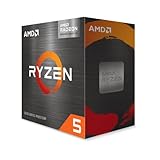
- Play some of the most popular games at 1080p with the fastest processor graphics in the world, no graphics card required
- 4.6 GHz Max Boost, unlocked for overclocking, 20 MB cache, DDR4-3200 support
- For the advanced Socket AM4 platform
Rank #4

- The Socket AM5 socket allows processor to be placed on the PCB without soldering
- Ryzen 5 product line processor for your convenience and optimal usage
- 5 nm process technology for reliable performance with maximum productivity
- Hexa-core (6 Core) processor core helps processor process data in a dependable and timely manner with maximum productivity
- 6 MB L2 plus 32 MB L3 cache memory provides excellent hit rate in short access time enabling improved system performance
Product prices and availability are accurate as of the date/time indicated and are subject to change. Any price and availability information displayed on Amazon at the time of purchase will apply.

