
Recommended Free Tools
iTechGuides is reader-supported. When you buy through links on our site, we may earn an affiliate commission. As an Amazon Associate I earn from qualifying purchases. Learn more
A credible assessment of project results starts before any data is collected. Name the people who will use the findings and the decisions those findings should inform, show how project activities are expected to produce outcomes, then choose questions, indicators, and an evaluation design that can support the conclusions you want to draw. Claims about what the project caused need a stronger design than claims about what was achieved, and the findings should say which is which.
The approach below is general. It is meant for any project, whether a development intervention, a public program, or an internal initiative. The specific questions, indicators, and methods have to be adapted to the intervention, its stakeholders, and the decisions it is meant to inform.
Start with the users and the decision
Before choosing methods, write down who will read the evaluation and what they will do with it. The purpose may be improving the project while it runs, deciding where to allocate resources, meeting an accountability requirement, or planning a successor project. Each purpose asks for different questions and different levels of evidence, and an evaluation that tries to serve all of them at once often answers none of them well.
The CDC’s Program Evaluation Framework, updated in 2024, lays out a practical sequence that works for projects outside public health as well:
#1 Best Overall
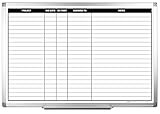
- MAGNETIC DRY-ERASE SURFACE — The whiteboard design is permanently printed onto durable, industrial‑quality dry‑erase vinyl that won’t smudge and is resistant to stains and ghosting. Its smooth, long‑lasting writing surface is also magnetic, giving you added functionality for notes, magnets, and accessories
- EASY INSTALLATION — Comes complete with durable mounting brackets and hardware, ensuring a secure and effortless wall‑mounting
- DURABLE ALUMINUM FRAME — Built with a sleek 1" aluminum border and a spacious 2.5" deep aluminum tray to keep markers and accessories neatly within reach
- SPACIOUS WRITING SURFACE — Ample writing space with a usable area that extends nearly edge‑to‑edge, measuring just 2" shy of the board’s total dimensions
- Please inspect your whiteboard upon arrival — If you notice any issues, please contact us through Amazon's Buyer-Seller Messaging system
- Assess the context in which the project operates.
- Describe the project, including its need, inputs, activities, and expected results.
- Focus the evaluation questions and choose a design.
- Gather credible evidence.
- Generate and support conclusions.
- Act on the findings.
The framework also asks evaluators to carry three commitments through every step: engage stakeholders collaboratively, promote fair and just evaluation practices and outcomes, and learn from and use what the evaluation reveals. It is designed as a guide rather than a fixed formula, so treat the sequence as a checklist of things to consider, not steps to complete in a rigid order. Source: CDC Program Evaluation Framework.
Describe the project and its logic
An outcome can only be assessed against an expectation of what the project was supposed to change. Write that expectation down in the project’s own terms: the need it addresses, the inputs it uses, the activities it carries out, the outputs those activities produce, and the outcomes it hopes to achieve. Note the contextual factors, such as funding conditions, staffing, political or market conditions, or community circumstances, that could help or hinder the chain.
A logic model or roadmap makes this visible. It connects activities to outputs and to short-term, intermediate, and long-term outcomes. The most useful part is usually the set of assumptions linking each step, because that is where the project can fail without anyone noticing. For example, a training program might chain together like this:
Quick wins for a faster PC:
Fix the driver behind crashes, sound loss and screen glitchesFind Drivers →Repair Windows errors before they cause bigger problemsFix Now →Scan for outdated or missing drivers - takes under a minuteDriver Scan →Rank #2

- DRY ERASE PROJECT MANAGEMENT PLANNER: Be made of 250 gsm construction paper, laminated by special formula film that is erasable, make the surface resistant to ghosting or staining. We can erase easily even months later and use this work schedule board over and over again
- PRODUCTIVE PROJECT MANAGEMENT TOOLS: This project management board is a game changer and something physical for managing personal or team projects efficiently. It allows you or members to quickly view and share the status of up to 12 projects at the same time, a very good practical kit of team building
- SCRUM WHITEBOARD FOR OFFICE ESSENTIALS: This project organizer worth the investment for business use. It's easy to use for products development, marketing strategic projects or as a sales goal tracking whiteboard. You can easily measure budget, milestones, resources, inventory and timeline at a glance. It helps you plan, execute, assign tasks efficiently
- MOUNTING IS A BREEZE: This vision board is lightweight and comes with removable mounting stickers. You can mount this program Management Board easily without tools. On the other hand, you can take it down easily too if you need to remount your project board to other place later
- COMPLETE ACCESSORIES INCLUDED: Our huge project manager planner for wall is cost-efficient for daily use in office, home office or family. It comes rolled in a study tube with, premium dry erase eraser, reusable fluorescent colored tabs for entrepreneurs, managers or person working at home
- Activity: a three-day training course for clinic staff.
- Output: staff complete the course.
- Short-term outcome: staff can describe and apply the new protocol.
- Intermediate outcome: the protocol is used in routine consultations.
- Long-term outcome: patient results improve.
Each arrow is an assumption. The assumption that staff who can describe the protocol will use it is testable in its own right, and it should be listed so the evaluation can check it.
Choose criteria and questions that fit the project
The OECD Development Assistance Committee offers six complementary criteria for evaluating development and other interventions where they fit: relevance, coherence, effectiveness, efficiency, impact, and sustainability. Each addresses a different attribute of an intervention. OECD guidance is clear that they should be selected and interpreted according to the purpose, context, and stakeholder needs, and that they are not a method or a checklist to apply mechanically. The table below gives the plain-language question each criterion asks.
| Criterion | Question it asks |
|---|---|
| Relevance | Does the project respond to the needs it was designed to meet? |
| Coherence | Does the project fit with other efforts in the same setting? |
| Effectiveness | Is the intervention achieving its objectives? |
| Efficiency | Are resources being used well to deliver results? |
| Impact | What broader changes, intended or not, is the project producing? |
| Sustainability | Do the benefits continue after support ends? |
Effectiveness is the criterion most readers reach for first, and OECD guidance frames it as the question “Is the intervention achieving its objectives?” Keep the set of questions manageable. Five well-chosen questions tied to the decisions identified at the start will produce more useful findings than twenty questions drawn from a template. Source: OECD, Evaluation Criteria.
Rank #3
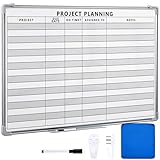
- Functional: the project planning dry erase whiteboard with lines is preprinted with common project planning templates, namely project name, due time, on time, assigned to, notes, to help you plan your project clearly and never miss the detail progress, keeping your business in order
- Easy to Write and Clean: this project planning whiteboard has a smooth and scratch resistant writing surface, allowing you to write smoothly and resist ghosting, it's easy to wipe without leaving stains
- Detail Specifications: our make ready white board with lines is made of quality materials, with aluminum frame, which is durable and sturdy; And it measures about 36x 24 inches in size, provide ample space to fully display project details
- Easy and Convenient to Apply: the large whiteboard planner for wall is equipped with sliding tray, convenient for you to store marker pens and more writing tools or magnetic accessories, keeping your room tidy; And its magnetic surface supports to apply magnetic pins or strips, making it easier to organize and update information
- Clear and Long Lasting Printing: this ruled dry erase white board adopts erasable design, vinyl printed decals, that is clear printing, not easy to fall off and fade, providing you with a long term application
Pick the evaluation type that matches the question
CDC describes evaluation as taking several forms, depending on purpose. None is universally superior, so choose by the question being asked.
The Tool Desk
Outbyte Driver Updater FREEScan for outdated or missing drivers - takes under a minuteDriver Scan →Outbyte PC Repair FREERepair Windows errors before they cause bigger problemsFix Now →- Formative evaluation supports improvement while the project is still being shaped or run.
- Process or implementation evaluation examines how the project was delivered and how that delivery relates to the intended theory of change.
- Outcome evaluation measures the extent to which intended outcomes were achieved.
- Impact evaluation assesses whether a causal relationship between the project and its outcomes can be established.
- Economic evaluation relates program effects to program costs.
A project that did not reach its participants may need a process evaluation before any outcome question is worth asking. A project that has delivered as planned but cannot show change may need an outcome evaluation with better indicators. Source for the typology: CDC, CDC Program Evaluation Framework, 2024 (MMWR).
Match indicators and data to each question
Each evaluation question needs evidence that directly represents the expected result it refers to. Define that result first, then choose an indicator that measures it, and specify the measure and the data source. An indicator with no named source is a plan that cannot yet be carried out.
Rank #4
- MAGNETIC DRY-ERASE SURFACE — The whiteboard design is permanently printed onto durable, industrial‑quality dry‑erase vinyl that won’t smudge and is resistant to stains and ghosting. Its smooth, long‑lasting writing surface is also magnetic, giving you added functionality for notes, magnets, and accessories
- EASY INSTALLATION — Comes complete with durable mounting brackets and hardware, ensuring a secure and effortless wall‑mounting
- DURABLE ALUMINUM FRAME — Built with a sleek 1" aluminum border and a spacious 2.5" deep aluminum tray to keep markers and accessories neatly within reach
- SPACIOUS WRITING SURFACE — Ample writing space with a usable area that extends nearly edge‑to‑edge, measuring just 2" shy of the board’s total dimensions
- Please inspect your whiteboard upon arrival — If you notice any issues, please contact us through Amazon's Buyer-Seller Messaging system
CDC recommends indicators that are SMART: Specific, Measurable, Achievable, Relevant, and Timebound. The same guidance calls for enough data of adequate quality, and for measures that may be quantitative or qualitative depending on the question. Before collecting anything new, check the following:
- Whether existing instruments or data sets can be adapted rather than built from scratch.
- Whether collection protocols will be applied consistently across sites, staff, and time periods.
- Whether the data plan addresses security, including who can access identifiable information and how it is stored.
Qualitative evidence, such as interviews, observation, or document review, often explains why an indicator moved or did not move. Treat it as part of the evidence base rather than an afterthought. The CDC’s detailed guidance on this step is in Step 4 – Gather Credible Evidence.
Achieved outcomes are not proof of cause
The most common overstatement in project reporting is treating an achieved outcome as evidence that the project produced it. An outcome evaluation measures the extent to which intended outcomes were achieved, but on its own it cannot attribute causality. An impact evaluation compares outcomes with and without the intervention, and is designed to test whether a causal relationship can be established.
Best Value

- Project Management Whiteboard: our 24" x18" aluminum-framed whiteboard with a double-sided design features a smooth, easy-to-write surface with clear lines; Nice as a weekly planner whiteboard, it helps track tasks, schedules, and project milestones without smudging or ghosting
- Versatile Schedule Board for Any Space: whether for office projects, home planning, or team coordination, this team task tracker keeps everything visible
- Ideal Dry Erase Board Project Planner: streamline tasks with a dedicated space for notes, deadlines, and reminders; The magnetic-free surface ( compatible with sticky notes) allows quick updates, while the white board layout ensures nothing gets overlooked
- Easy to Wipe Reuse Daily: the dry erase surface wipes clean effortlessly, leaving no residue; Reuse it endlessly for daily agendas, project tracking, or brainstorming—nice for offices, classrooms, or home centers
- Sturdy and Space-saving Design: the lightweight yet durable aluminum frame includes a built-in wall hook for easy hanging; Its compact 24"x18" size fits tight spaces while offering ample room for weekly planner whiteboard layouts, charts, or inspirational quotes
| Feature | Outcome evaluation | Impact evaluation |
|---|---|---|
| Main question | Were the intended outcomes achieved? | Did the intervention cause the outcomes? |
| Comparison required | Not required to describe achievement | Outcomes are compared with and without the intervention |
| Causal claim it supports | Association between project and outcome, without attribution on its own | A causal relationship, if the design and analysis can establish one |
Choose the design to match the claim you intend to make. If the findings will say the project caused a change, the design must rule out plausible alternative explanations, such as other programs, economic shifts, or changes in who was measured. If the findings will only say that outcomes were reached, state that clearly and avoid causal language. Limitations and alternative explanations belong in the findings, not in a footnote.
Choose a design the project can actually support
Method choice should weigh several factors together. Consider the evaluation purpose and questions, the context, the quality of available evidence, the strength of causal claim required, feasibility, available skills and resources, timing, ethics, and how useful the results will be to the intended users. CDC notes that the choice should balance evaluation goals, scale, timeline, feasibility, and resources. A rigorous design that cannot be finished before the decision it serves is less useful than a modest design delivered on time, provided its limits are stated.
Turn evidence into supported conclusions
Analyze and interpret the evidence against the questions and criteria you set at the start. The findings should explain what the evidence supports and where it is limited. Look at intended and unintended results alike, and check for differences across groups where they are relevant, because an average can hide a result that only some participants experienced.
CDC’s framework treats generating supported conclusions and acting on findings as separate steps. Prepare findings in a form people can use, help the intended users engage with them, and connect them to concrete decisions such as program improvement, resource allocation, accountability, or planning. Findings that arrive after the decision has been made are a failure of timing, even if they are technically correct.
Check the work against five quality standards
The CDC framework gives a short set of standards that can serve as a final check on any evaluation. In its words: “High-quality evaluation should consider these five evaluation standards: Relevance and utility; Rigor; Independence and objectivity; Transparency; Ethics.” (Centers for Disease Control and Prevention, Program Evaluation Framework, 2024.) Ask of each finding whether it is useful to its intended readers, whether the method is rigorous enough for the claim being made, whether the evaluators were independent enough to report unwelcome results, whether the methods and limitations are open to scrutiny, and whether the work respected the people it involved.
Quick Recap
Product prices and availability are accurate as of the date/time indicated and are subject to change. Any price and availability information displayed on Amazon at the time of purchase will apply.

