
iTechGuides is reader-supported. When you buy through links on our site, we may earn an affiliate commission. As an Amazon Associate I earn from qualifying purchases. Learn more
Measure a lithium-ion cell’s DC internal resistance (DCIR) by applying a controlled current pulse, measuring the resulting voltage change at a specified time, and calculating R = ΔV / ΔI. The result is meaningful only with its test conditions: state of charge (SOC), temperature, pulse direction and size, pulse duration, and voltage-sampling time.
What a DCIR measurement tells you
DCIR is resistance calculated from a cell’s voltage response to a change in current. During a pulse, the voltage initially changes in response to ohmic resistance, then continues to shift as slower polarization processes develop. Because that response changes over time, an immediate reading and one taken several seconds into the pulse do not represent the same measurement.
National Instruments notes that DCIR changes with SOC, temperature, and pulse duration; its Battery Cell Quality Toolkit manual describes short pulses of 1–10 seconds. Those are useful context, not a universal protocol. Always identify the sampling time used for the reported voltage. NI Battery Cell Quality Toolkit manual
Do these 3 things before closing this tab:
1Clear out junk files and repair common Windows errors2Fix the driver behind crashes, sound loss and screen glitches3Repair Windows errors before they cause bigger problemsCalculate DCIR from the current and voltage changes
For a discharge pulse, one practical expression is:
#1 Best Overall

- 【Upgrade Tester Clamp Probe】Compatible with All Battery Types. Easily test car battery tester, household battery, AA, AAA, and more using different tools
- 【Voltage Internal Resistance Battery Tester】FNIRSI battery tester can automatically test internal resistance and voltage value at the same time. The measured value can be used to determine whether the battery quality has decreased
- 【Milliohm Meter】Designed for professionals on the go, this lightweight, compact device delivers accurate low-resistance measurements, making it ideal for detailed battery diagnostics across various environments
- 【Measuring Range】The resistance measurement range is up to 200Ω and the voltage measurement range is up to 100 V. The device must not be used with a DC voltage higher than 100V. Do not apply AC voltage under any circumstances
- 【TFT HD Color Display】The display adopts advanced color HD technology and excellent layout. Compared with traditional monochrome displays, it can present test results more clearly and vividly, greatly enhancing the user's measurement experience
R = (Vbefore − Vloaded) / (Iloaded − Ibefore)
Use voltage and current readings taken at the defined points in the test, and keep the sign convention consistent. If current begins at zero, the expression reduces to the voltage drop divided by the pulse current. State the sampling point for Vloaded; otherwise the resistance value cannot be interpreted or reproduced reliably. Tektronix application note on measuring battery DCIR
Run a reproducible pulse test
- Define the method. Record cell format, charge or discharge direction, pulse current or C-rate, pulse duration, voltage-sampling time, and the protocol you intend to follow.
- Set the cell conditions. Bring the cell to the target SOC and temperature. Rest or condition it as required by the selected method, and record what you did.
- Connect the measurement equipment. Attach voltage-sense leads at the cell terminals. For low-resistance measurements, use four-wire sensing so voltage readings exclude most of the voltage drop in the current-carrying leads.
- Capture baseline and pulse readings. Measure voltage and current before the pulse, apply the controlled current, then measure both again at the specified time.
- Calculate and report. Calculate ΔV/ΔI and record the sign convention, SOC, temperature, current, pulse duration, and sampling time alongside the result.
This is a general workflow, not a universal compliance procedure. For example, text for IEC 61960:2011 reproduced by the standards catalog iTeh describes cell conditioning at 20 °C ± 5 °C and a discharge-current method using 0.2 It, with voltage measured at the end of a 10-second discharge period. The cited page is a catalog reproduction, not an official IEC publication; verify the official standard edition and scope before claiming compliance. IEC 61960:2011 catalog reproduction
Rank #2
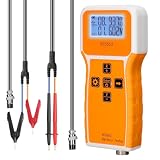
- 【Internal resistance & Voltage measurement】The battery tester can measure the battery internal resistance and voltage at the same time, this tool using four-wire test clamp, can better avert the influence of contact resistance and wire resistance, can carry out more accurate measurement.
- 【Clear & Backlight LCD Display】The digital battery tester features a Large LCD display screen that showcases the internal resistance, voltage and battery level of the tested battery, easy to read; The battery level is presented in battery level bar display, providing clear and precise information about the battery's status.
- 【Kalman Filter Mathematical Algorithm】This product adopts intelligent control, implanting Kalman filter mathematical algorithm, with high efficiency. It can also be used to measure the AC resistance of resistors and low-resistance high-precision resistance.
- 【Port Communication & Computer Analysis 】This product supports serial ports, and the measuring ranges of resistance is 1μΩ~200Ω, and the measuring ranges of voltage is 0.0001V~±100V direct current. Added serial port communication computer analysis software. Serial port needs to be opened in the machine to be able to communicate with the computer, the default is closed, the baud rate is 115200.
- 【Light Weight & Energy Saving】This tester built-in 1000mAh lithium battery to provide long service time, you can use the USB cable to charge in time. Portable size and easy to carry, you can take it with you to anywhere you want to use.
NI’s manual describes ISO 12405 as commonly using a 10–18 second pulse for peak-power capability assessment and HPPC as a broader approach that evaluates DCIR at different SOCs. Treat these as pointers to methods, not replacements for checking the applicable primary standard and edition. NI Battery Cell Quality Toolkit manual
Recommended Free Tools
Choose equipment that can deliver and measure the pulse
A source measure unit (SMU) can source or sink controlled current while measuring voltage. A battery test system may be a better fit for programmed or repeated pulse protocols. Select equipment against the actual test requirements rather than assuming one instrument suits every cell or method.
Rank #3

- 【WIDE APPLICATION BATTERY TESTER】The FNIRSI HRM-10 battery tester is not only able to test car batteries, but also other types of batteries such as AA, AAA batteries, button batteries, lithuim batteries, lead-acid batteries,etc. The range of DC voltage is 0 - ±100V and resistance 0 - 200Ω. NOTE: The device must not be used with a DC voltage higher than 100V. Do not apply AC voltage under any circumstances.
- 【 KELVIN FOUR-TERMINAL SENSING】The FNIRSI HRM-10 comes with a kelvin clip test line. With Kelvin four terminal sensing, it can be possible to accurately measure resistance values less than 0.1 Ω while eliminating the inherent resistance of the lead wires connecting the measurement instrument to the component being measured. It will provide you accurate values and help you identify the problematic batteries.
- 【 DATA PRESET FUNCTION】The FNIRSI HRM-10 battery tester has auto mode.Voltage gears is: Automatic, 1V, 10V, 100V and the resistance gear is :Automatic, 20mΩ, 200mΩ, 2Ω, 20Ω, 200Ω. You could preset 8 sets of data and check if the batteries can meet the standard you set and help you quickly find out the problematic batteries.
- 【NO DATA WOULD BE MISSED】The FNIRSI HRM-10 internal resistance tester can automatically save all the test records. And you could connect the tester to your PC and transfer all the data to PC via EXCEL. It would be convenient for you to analyze.
- 【FASHIONABLE DESIGN AND COLORFUL DISPLAY SCREEN】Testing euipment need to be more cooler and user-friendly. This is the principle we live up to when we design the product. The display of FNIRSI battery tester adopts advanced color HD technology and was designed with excellent layout. Compared with traditional monochrome displays, it can present test results more clearly and vividly, greatly enhancing the user's measurement experience.
- Current output: The instrument must deliver the required pulse current in the intended direction.
- Voltage measurement: Check the voltage range and resolution needed to capture the cell’s response.
- Timing: Confirm the system can apply the pulse and sample voltage at the required time point.
- Four-wire sensing: Verify that the instrument and leads support Kelvin sensing when lead resistance could materially affect the result.
- Automation: For repeated tests, confirm support for programmed pulse sequences and data capture.
Tektronix demonstrates DCIR measurement using a Keithley 2461 High Current SMU and an Ultralast 3400 mAh 18650 cell. Its application note explains that four-wire connections are needed to eliminate lead-resistance errors because cell internal resistance is typically below one ohm. This is an example setup, not a universal equipment recommendation. Tektronix application note For programmed pulse-testing workflows, Maccor describes battery test systems used in research. Maccor pulse-testing guidance
Make DCIR results comparable
Two DCIR figures are directly comparable only when their test conditions are sufficiently alike. Match these factors where possible, or disclose differences:
Rank #4

- 【Battery Internal Resistance Tester】ZOYI XR1 Battery Internal Resistance Tester automatically measures battery internal resistance and voltage values with simultaneous display. Measurement data helps determine battery quality degradation or continued usability. Supports historical
- 【Digital Multimeter】XR1 integrates a 25,000-count digital multimeter featuring AC/DC voltage, resistance, capacitance, frequency, temperature, diode test, and continuity check functions. Serves as both battery quality inspector and maintenance tool.
- 【Kelvin Clip Testing】Utilizes 4-wire Kelvin clips to minimize lead and contact resistance, enhancing measurement accuracy. Supports manual voltage and resistance range adjustment.
- 【Technical Specifications】Resistance range: 0.1mΩ-200Ω (adjustable). Voltage range: 100V (maximum input). Auto-shutdown timer: 5-120 minutes (configurable). Buzzer volume: 0-100% adjustable.
- 【Industrial Design】Features TFT color display with enhanced clarity and vibrant visualization. Screen brightness: 10%-100% adjustable. Type-C charging interface for modern power supply solutions.
- Cell SOC and temperature
- Charge or discharge direction and pulse current or C-rate
- Pulse duration and voltage-sampling time
- Rest or conditioning procedure
- Measurement connection and instrument method
When comparing equipment rather than cells, focus on current output range, voltage range and resolution, pulse timing, four-wire sensing, and automation support. An unexplained resistance number, even if reported in the same units, may reflect a different point in the cell’s voltage response.
DCIR is not the same as AC internal resistance
DCIR is derived from a current pulse and includes the voltage response over the chosen pulse interval, including time-dependent polarization effects. AC internal resistance (ACIR), often measured at 1 kHz, is a different measurement focused on impedance at that excitation frequency. Do not substitute an ACIR value for DCIR without explaining the method and why it answers the same question.
Best Value

- WIDE COMPATIBILITY: The easy-to-use battery tester with test leads, not only works all common batteries but also has a quality feel ensures hold up to long use. It fully works with A, AA, AAA, AAAA, C, SC, D, 9V, 3.7V Li-ion 26650, 21700, 18650, 16340(CR123), 10440, CR2, CRV3, 2CR5, CR-P2, A10, A13, and also handles a very wide range of button cells(LR621, CR2032) etc
- LARGE LCD SCREEN: Fully and clearly informed about the battery under test, it helps you easily and quickly finds out how much power your battery has to determine if they are charged or need replacement. Get a longer battery lifespan by not overcharging partially full rechargeable batteries
- RELIABLE & MULTIFUNCTIONAL: With its high ability to detect battery capacity percentage, battery voltage, and battery internal resistance, the precise universal battery meter is great for finding out if your EDC devices need new batteries or if it was device faulty. Such as kids' toys, flashlights, controllers, cameras, etc
- PORTABLE & EASILY USE: A versatile digital battery voltmeter that is easy to use and remarkably handy size. No need to insert your test battery into any bays, just selecting the corresponding voltage via the rotary dial and then connect the contacts well through the test leads and the digital checker will quickly provide you a reliable and accurate source of energy your test battery
- WHAT YOU GET: Dlyfull battery health tester & checker, 2x 1.5V AAA batteries(pre-install), welcome guide, and our worry-free 18 months warranty, no hassles friendly customer service and lifetime technical support
The IEC 61960:2011 text reproduced by iTeh describes a separate AC method using a 1 kHz ± 0.1 kHz excitation for 1–5 seconds. The catalog reproduction of IEC 61960-4:2024 addresses AC resistance for coin secondary lithium cells. Confirm the applicable official edition and scope for a standards-based test. IEC 61960:2011 catalog reproduction IEC 61960-4:2024 catalog reproduction
Quick Recap
Product prices and availability are accurate as of the date/time indicated and are subject to change. Any price and availability information displayed on Amazon at the time of purchase will apply.

