
iTechGuides is reader-supported. When you buy through links on our site, we may earn an affiliate commission. As an Amazon Associate I earn from qualifying purchases. Learn more
Keep opened filament in a genuinely sealed bag or dry box with desiccant, store it somewhere cool and away from sunlight, and return the spool to that protected container as soon as printing ends. If the spool is already damp, dry it at a temperature and duration recommended for that material before storing it again. Storage limits new moisture exposure; it does not reliably dry a wet spool.
Why keeping filament dry matters
Most 3D-printing plastics are affected by the water vapor in ordinary room air, but they do not all absorb it at the same rate. Polyamide (nylon) is substantially more moisture-sensitive than PLA, while PETG, CPE, PET CF and flexible TPU95A can also show moisture-related problems. A spool left exposed may produce rougher surfaces and weaker mechanical properties. Depending on the material and how much moisture it has taken up, you may also see stringing, oozing, popping or inconsistent extrusion.
Moisture is only one possible cause of a print defect. A wet spool can resemble a temperature, retraction, nozzle or mechanical problem, so use the storage and drying steps below as a controlled troubleshooting path rather than assuming every string or blob proves water damage. UltiMaker and Prusa both emphasize that material formulation affects sensitivity.
Free tools Windows power users keep installed
One-click scans. No signup required.
Temperature, humidity and ultraviolet exposure all matter. A cool, shaded cupboard is safer than a warm shelf beside a window, radiator or printer enclosure vent. There is no universal number of “safe” hours in room air for every filament: the acceptable exposure depends on the polymer, additives, local humidity and the condition of the spool.
#1 Best Overall

- Large Storage Volume -Filament Dry Box Inner Size: 9.29*6.49*9.13 inch. Comgrow dryer box can store 2 rolls of 1kg spools, compatible with PLA ABS SILK filament. Works perfectly with all standard filament diameters 1.75mm/2.85mm.
- Setting Notes - Set the temperature and duration after turning on the filament dehydrator. The machine will work only when the work state is displayed on the screen. If the work mode is not displayed, the motherboard will automatically shut down after 3 minutes. If you have any unsolvable problems with the COMGROW filament dryer box, please feel free to contact us, our after-sales technical team will provide you with detailed solutions within 24 hours.
- Filament Dryer and Remove Moisture - Comgrow 3d printer filament dryer box is designed to keep filament dry and remove moisture from kinds of filaments. Internal heating during printing provides a dry storage environment for 3D printer filaments and keeps the filament dry. Avoid entanglement, clogging, poor adhesion, and layer migration caused by the dampness of the printing wire. (Note: Only used for the drying of 3D printer Filament)
- Real-time Monitoring of Temperature and Humidity - Adjustable temperature range 40°~ 50 °C, the maximum temperature is only 50°C,。setting time from 6 hours to 12 hours. A 2-inch LCD screen and touch buttons make it easy to operate, it is more comprehensive and clear of the information display. Press the power button to start, and hold the function button(M) to change the dry time and the temperature setting.
- Great Sealed Filament Dry Box -The outlet structure adopts a silicone cable sheath and Teflon tube, the outlet is smooth and can be covered with a plug when not in use. The upper cover has a snap button structure, and the sealing performance is good.When the drying box is working, the sealing hole needs to be opened to allow moisture to drain out. When not in use, the sealing hole needs to be closed to keep the consumables dry.
Five storage tricks that work
1. Reseal every opened spool
As soon as a print job is finished, put the spool back into a container that closes around it. A resealable bag is the simplest option; a humidity-controlled box is another. Remove as much excess air as practical, close the seal fully and check that the filament does not pinch the closure open.
UltiMaker recommends resealable bags with desiccant or humidity-controlled storage, and Prusa describes vacuum bags as an additional option. The goal is not to create a perfect vacuum; it is to stop a continuous exchange of damp room air with the air around the filament.
2. Put desiccant inside the sealed container
Place a dry desiccant pack in the bag or box with the spool. Silica-gel packs are commonly used because they capture water vapor in the enclosed air. Keep the packet from tangling with the filament and replace or regenerate it according to the packet maker’s instructions when it becomes saturated.
Quick wins for a faster PC:
Scan for outdated or missing drivers - takes under a minuteDriver Scan →Repair Windows errors before they cause bigger problemsFix Now →Desiccant improves a sealed container’s ability to stay dry, but no fixed number or size of packets guarantees a particular relative humidity. A large spool, frequent opening, humid room or wet desiccant can overwhelm a small pack. Treat desiccant as one part of a sealed system, not as a substitute for closing the container.
Rank #2

- [Fast Drying with Fan] SUNLU 3D printer filament dry box can help you solve the problem of stringing, clogging and poor adhesion caused by wet filament.Upgraded filament dryer adds a fan design,speeding up the discharge of excess water from 3D printer filaments and reducing the impact of wet weather on 3D filament printing.
- [Visual Display] SUNLU dry box can accurately detect and display the temperature,time,humidity in the 2 inch LCD screen.Hold the left button to change the dry time, press the right button to change the temperature setting.
- [Personalized Settings] You can adjust the temperature and time of 3d filament dryer according to different filament and environment.Adjustable temperature range is 35℃-55℃.After using the drying box, the print quality is better,surface smoother,good layer adhesion.
- [High Compatibility] Maximum capacity of filament box is 210*89(H)mm. Ideal for all 3d printing filament 1.75mm/2.85mm/3.00mm PLA PETG ABS TPU Nylon PA filament material. Compatible with all major 3D printer filament brands.
- [Customer Service] After-Sales Service and Technical Support are provided.If you have any question about SUNLU 3D printer filament dryer S1 Plus, please don't hesitate to contact us.You can add the dryer box to shopping cart first to help quick finding.
3. Use a dry box when you access a spool often
A dry box is useful when a spool is mounted on the printer for repeated jobs. It reduces the spool’s contact with room air and can let filament feed through a guide while the lid remains closed. This is more convenient than repeatedly opening a storage bag, especially for nylon and other moisture-sensitive materials.
Check the device’s actual function. Some boxes are passive storage containers with desiccant; others include a heater and controls that actively dry filament. Prusa’s USS Drybox guidance says a dry box slows moisture absorption but that already-moist filament needs pre-drying. Do not assume that a box advertised as “dry” will restore a wet spool unless it specifies controlled heating and a drying procedure.
4. Store spools cool and out of direct sunlight
Choose a stable indoor location away from windows, radiators, hot electronics and direct ultraviolet light. UltiMaker identifies temperature, UV exposure and humidity as relevant storage conditions and gives material-specific ranges in its storage guidance. Avoid leaving a sealed bag in a hot car or a sunlit enclosure: heat can deform the spool or soften filament, while UV can age some plastics even when humidity is controlled.
Do not confuse “cool” with refrigeration. Condensation can form when a cold spool is moved into warm, humid air. Normal indoor storage in a shaded, dry cabinet is generally easier to manage; if you use any unusually cold location, let the sealed container return to room temperature before opening it.
Rank #3

- 4 Spool Capacity: SUNLU 3D printer filament dryer S4 can dry up to four 1kg 3D printer filaments, enhancing drying efficiency and printing quality when drying while printing
- Large Dimensions: SUNLU filament dryer S4 is notably large in size with external dimensions of 460(L) * 220(W) * 310(H)mm, internal dimensions of 450(L) * 175(W) * 207(H)mm, and net weight of 4KG
- 8 Filament Exit Holes: SUNLU filament dryer S4 features eight filament outlets for multiple printers and various filament loading angles, ensuring smoother loading and printing
- 350W PTC Heater: SUNLU filament dryer S4 is equipped with a 350W PTC heater, offering safety and higher heating efficiency (50% higher than the FilaDryer S2)
- 3 Circulation Fans: Three high-quality fans circulate air inside, ensuring consistent temperature across the entire area for more even drying with 360 surround heating
5. Return filament promptly after printing
Do not leave a spool sitting beside the printer for convenience. Put it back in its sealed bag or dry box after the final job, with its desiccant in place. UltiMaker notes that brief ambient exposure during transfer does not significantly affect quality when the spool is returned promptly to a dry environment. That is different from leaving it exposed overnight or between jobs for days; the cited guidance does not establish one universal safe exposure time.
Choosing a storage method
Use the following comparison to match the container to your workflow. The important distinctions are seal quality, how often you need access, spool capacity, desiccant handling and whether the device only stores filament or also heats it.
| Method | Best use | What it does | What to verify |
|---|---|---|---|
| Resealable bag with desiccant | Most opened spools and occasional printing | Creates a low-moisture enclosure when closed and supplied with dry desiccant | Seal closes completely; desiccant is present and still effective; bag fits the spool without forcing the zipper open |
| Vacuum bag with desiccant | Longer-term storage or spools used infrequently | Removes much of the air before sealing, reducing the amount of humid air around the filament | Bag and valve remain airtight; spool edges do not puncture the plastic; reopen and reseal after each use |
| Passive dry box | A spool that stays mounted and feeds into the printer | Limits exposure while allowing convenient access; usually relies on desiccant | Whether it has a real gasket, usable filament feed-through and replaceable or regenerable desiccant |
| Heated filament dryer | Wet filament that must be conditioned before printing | Holds a selected temperature for a selected period while managing humidity | Temperature range, spool-size limits, manufacturer settings and whether the unit can safely dry that polymer |
No controlled head-to-head test establishes one storage product as universally superior. A well-sealed inexpensive bag can outperform a poorly closed box, while a heated dryer solves a different problem from passive storage.
PC Slower Than It Used to Be?
A free scan shows the junk files, broken settings and background clutter dragging Windows down - then fixes them in one click.Free scan · Windows 10 & 11Crashes, No Sound, or Screen Glitches?
Random freezes, missing sound and display glitches usually trace back to one bad driver. Find and replace yours safely.Free scan · under a minuteHow to dry a spool that is already damp
Storage prevents additional moisture uptake; it does not necessarily remove water already absorbed into the polymer. If you hear crackling or popping at the nozzle, see sudden stringing or oozing, or observe degraded surface quality after checking ordinary print settings, dry the spool before returning it to storage.
Rank #4
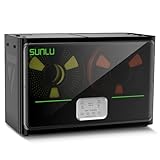
- 4 Spool Capacity: SUNLU 3D printer filament dryer S4 can dry up to four 1kg 3D printer filaments, enhancing drying efficiency and printing quality when drying while printing
- 3 Circulation Fans: Three high-quality fans circulate air inside, ensuring consistent temperature across the entire area for more even drying, 360 surround heating
- 350W PTC Heater: SUNLU filament dryer S4 is equipped with a 350W PTC heater, offering safety and higher heating efficiency (50% higher than the FilaDryer S2)
- 8 Filament Exit Holes: SUNLU filament dryer S4 features eight filament outlets for multiple printers and various filament loading angles, smoother loading and printing
- Personalized Temperature Setting and Timer: Temperature setting range is 35-70C, timer setting range is 0-99 hours. Users can adjust parameters to suit filament conditions
- Identify the exact material. Read the label or manufacturer’s technical guidance. “Nylon,” “PETG” and “PLA” are broad categories, and additives or blends can change the safe temperature.
- Use a dedicated apparatus. A temperature-controlled filament dryer or another device specifically designed to hold a set temperature for a set period is preferable to an improvised heat source. Check the dryer’s maximum temperature and spool clearance first.
- Set the material-specific temperature and time. Use the manufacturer’s recommendation, not a generic setting. The example values below come from UltiMaker’s guidance and are not universal for every brand or formulation.
- Let the spool cool while protected. When the cycle ends, keep the spool in the dryer with its lid closed, or transfer it directly into a sealed bag or dry box containing dry desiccant. Do not place a hot, newly dried spool on an exposed desk in humid air.
- Print a controlled test. Check extrusion, surface finish and stringing with the same nozzle and slicer settings you used before. If the symptoms remain, investigate temperature, retraction, nozzle condition and feed-path friction rather than repeatedly increasing heat.
Material-specific drying examples
The following settings are examples published by UltiMaker. They are manufacturer recommendations, with no year stated on the accessed support page. They should not replace the filament maker’s own instructions.
| Material | UltiMaker example | Important qualification |
|---|---|---|
| PLA | 40–50 °C for 4–8 hours | Use the lower temperature if the spool or formulation has a lower heat limit; verify the brand’s guidance. |
| Nylon | 50–60 °C for 24 hours or longer | Nylon is highly moisture-sensitive and may need overnight drying or an even longer cycle. |
| PETG | 65 °C for 4–8 hours, or 70 °C for 10–20 hours | Confirm that the spool, additives and dryer tolerate the selected temperature. |
These times are not promises that a spool will be dry after exactly one cycle. Particularly moisture-sensitive filament may need longer, and a heavily wet spool can require repeated cycles. If the material maker publishes a different range, follow that guidance and stay within the dryer’s limits.
Independent reader supportYour contribution helps us test, update, and keep practical guides available for everyone.Symptoms, checks and fixes
Stringing or oozing
Moisture can contribute to stringing and oozing, especially with TPU95A and nylon and, to a lesser extent, PETG, CPE and PET CF. Dry the filament using the correct procedure, then retest before changing retraction dramatically. If drying makes no difference, check nozzle temperature and retraction settings.
The Tool Desk
Outbyte Driver Updater FREEScan for outdated or missing drivers - takes under a minuteDriver Scan →Outbyte PC Repair FREEClear out junk files and repair common Windows errorsFree Scan →Rough surfaces or weakened parts
UltiMaker reports that moisture can reduce surface quality and mechanical properties. Compare a dried spool with a known-good sample using identical settings. Also check layer temperature, cooling, extrusion calibration and whether the part design itself creates weak areas.
Best Value

- 【Upgraded PTC Solution】Creality Space PI SE heats up quickly and has a built-in fan that circulates the hot air through 360° inside the chamber, evenly heating the entire chamber. It can be heated to 65°C within 15 minutes. We have added thermal insulation cotton on the dryer box inner wall to keep warm and anti-scald when printing. Dryer box input voltage: 110V 50/60Hz
- 【Improved Print Quality】3D printing filaments are hygroscopic, moisture can cause printing failure. After using filament dryer box, it can effectively solve the problems of drawing, clogging, and poor adhesion of the filaments during printing and improve print quality
- 【Easy to Use】Creality filament storage box requires no assembly and can be used right out of the dry box. Display screen and knob make it easy to operate. Real-time humidity monitoring and drying hours are displayed via a countdown timer, allowing you to track drying conditions. After drying, it is best to store the filament in a vacuum bag to keep it dry and ready for use
- 【Personalized Drying Time/Temperature Setting】You can set different drying temperatures and time to dry the filaments fully according to different 3D filament type, ambient temperature, humidity and other factors. Adjustable temperature range 45℃~65℃, and the time setting range is 0~24 hours
- 【Wide Compatibility】Creality filament dryer compatible with most 1KG spool 3D Printer filament. It can perfectly fit filament diameters of 1.75mm/2.85mm. And can be used with a variety of filaments, such as PLA, PLA+, PETG, TPU, ABS, ASA, PP, PC,PA(nylon). Pairing with Teflon tubes can make the filament feeding smoother
Popping, crackling or irregular extrusion
Audible popping often indicates vaporizing moisture, but a partially blocked nozzle or inconsistent drive-gear tension can create similar symptoms. Dry the spool first, inspect the nozzle and confirm that the filament path is not dragging. Keep the spool enclosed during the test so it does not reabsorb moisture immediately.
A dry box did not cure the problem
That result is expected if the filament entered the box already wet. Passive boxes slow further absorption; they are not automatically dryers. Use a controlled drying cycle, then return the conditioned spool to the box with effective desiccant.
A repeatable storage routine
Label each spool with its material and, if useful, the date it was opened or dried. Keep high-sensitivity materials such as nylon in sealed storage whenever they are not actively feeding the printer. Before a long print, check that the bag or box seal is intact and that the desiccant has not been exhausted. After printing, cut or secure the filament end so it cannot unwind, close the container immediately and keep the spool in the same cool, shaded location.
Do these 3 things before closing this tab:
1Scan for outdated or missing drivers - takes under a minute2Clear out junk files and repair common Windows errors3Fix the driver behind crashes, sound loss and screen glitchesFor a spool that has been exposed in a humid room, do not guess at a universal recovery time. Dry it according to the material maker’s instructions, protect it while cooling, and judge the result with a controlled test print. This routine separates prevention from recovery: sealed storage limits new moisture, while controlled heating removes moisture that the polymer has already absorbed.
Quick Recap
Product prices and availability are accurate as of the date/time indicated and are subject to change. Any price and availability information displayed on Amazon at the time of purchase will apply.

