
iTechGuides is reader-supported. When you buy through links on our site, we may earn an affiliate commission. As an Amazon Associate I earn from qualifying purchases. Learn more
A missing feature is not, by itself, a reason to replace your 3D printer. Upgrade when a specific limitation is disrupting the materials you use or the way you print—and only after confirming that a compatible retrofit is practical. These five capabilities can improve convenience or expand what a printer can handle, but none guarantees better prints or makes every older machine obsolete.
1. Automatic bed leveling: useful when setup is the obstacle
A leveling sensor or mesh-calibration system can reduce the time spent setting up the print bed. This matters most if inconsistent first layers or repeated manual adjustments are a recurring problem. Creality lists automatic leveling on its Ender-3 V3 Plus, and Snapmaker discusses automatic leveling as an upgrade option in its 3D printer upgrade guide.
Before buying a sensor, check that it is designed for your exact printer model and works with the installed firmware. The sensor may also require compatible mounting hardware, wiring, configuration, or firmware changes. If your current bed setup is reliable, the feature alone may not justify an upgrade.
Windows Errors? Fix Them Before They Spread
Repair common Windows errors and clear accumulated junk for a smoother, more stable PC - no reinstall needed.Free scan · no reinstallOutdated Drivers Are Slowing You Down
One free scan finds every outdated or missing driver and matches the right update for your exact hardware.Free scan · exact hardware match2. Direct-drive extrusion: match it to your filament and workflow
In a direct-drive setup, the extruder sits at or near the hotend. A Bowden setup instead pushes filament through a longer tube. Direct drive is a common feature on current printer listings, including the Ender-3 V3 Plus and Bambu Lab’s P1 series.
#1 Best Overall

- Up to 16 Colors: Bring your designs to life with vibrant multi-color/multi-material printing capabilities, perfect for showcasing your creativity. Note: Connecting Bambu Lab AMS is required.
- 500mm/s and 20000 mm/s² Acceleration True High Speed: Don't wait around for your masterpieces. Lightning-fast printing speed lets you focus on creating, not waiting.
- Enclosed Design: Fully enclosed body improves print performance for advanced filaments. Automatic Bed Leveling: Say hello to high-quality, successful prints. Auto bed leveling makes 3D printing such an easy thing.
- Set Up in 15 Minutes: Spend more time printing and less time setting up. User-friendly design ensures a hassle-free assembly experience for all skill levels.
- Supported Filament: Ideal: PLA, PETG, TPU, PVA, PET ABS, ASA; Capable : PA, PC; Not Recommended: Carbon/Glass Fiber Reinforced Polymer.
That does not mean a direct-drive conversion automatically improves print quality or speed. Consider one when a material or extrusion task you actually use is poorly served by your current arrangement. Check that the conversion kit fits your printer and hotend, and account for any firmware or configuration work before deciding whether a retrofit is preferable to replacing the machine.
3. Filament runout detection: helpful, but not a guarantee
A runout sensor detects when filament has run out and may pause the printer or alert you, depending on the machine’s implementation. Creality lists a runout sensor on the Ender-3 V3 Plus; Bambu Lab lists filament runout sensing for its P1 series.
Rank #2

- One-Click Automatic Printing: Experience hassle-free 3D printing with the Adventurer 5M Series. Enjoy automatic bed leveling for flawless first layers, ensuring consistent adhesion and saving time with no manual adjustments required.
- 12X Ultra Fast Printing: Featuring a CoreXY structure with 600mm/s travel speed and 20000mm/s² acceleration, the AD5M maximizes efficiency, reduces production cycles, and ensures high precision, making it ideal for rapid prototyping and mass production.
- Smart and Efficient Design: Quick 3-second nozzle changes, a high-flow 32mm³/s nozzle, and fast 35-second warm-up to 200°C deliver stable high-speed printing. Its dual-sided PEI platform and versatile options provide easy removal and adaptability for various creative projects.
- Superior Print Quality & Adaptability: Combines a 280°C direct drive extruder with dual-fan cooling and vibration compensation. Includes a standard 0.4mm nozzle and accepts optional sizes from 0.25mm to 0.8mm to fit various printing needs.
- Real-Time App Monitoring: Monitor print progress, adjust settings, and receive instant status alerts remotely with the Flash Studio. Smart mobile control ensures a seamless, effortless printing experience anytime, anywhere.
Detection can help when a spool runs empty during a job, but it cannot prevent every failed print. Before retrofitting a sensor, verify that your printer’s electronics and firmware support it and find out what the printer actually does when the sensor triggers.
4. Power-loss recovery: check what your printer can resume
Power-loss recovery is listed on both the Ender-3 V3 Plus and Bambu Lab’s P1 series. The feature is intended to help resume a print after an outage, but its behavior depends on the printer’s hardware, firmware, and the conditions of the interrupted job.
Rank #3
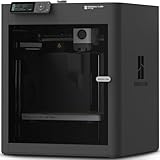
- Up to 16 Colors: Bring your designs to life with vibrant multi-color/multi-material printing capabilities, perfect for showcasing your creativity. Note: Connecting Bambu Lab AMS is required.
- 500mm/s and 20000 mm/s² Acceleration True High Speed: Don't wait around for your masterpieces. Lightning-fast printing speed lets you focus on creating, not waiting.
- Enclosed Design: Fully enclosed body improves print performance for advanced filaments. Automatic Bed Leveling: Say hello to high-quality, successful prints. Auto bed leveling makes 3D printing such an easy thing.
- Set Up in 15 Minutes: Spend more time printing and less time setting up. User-friendly design ensures a hassle-free assembly experience for all skill levels.
- Supported Filament: Ideal: PLA, PETG, TPU, PVA, PET ABS, ASA; Capable : PA, PC; Not Recommended: Carbon/Glass Fiber Reinforced Polymer.
If outages are a concern, check your current printer’s documentation for recovery support and the exact way it handles an interruption. Do not treat the feature as a guarantee that every print will resume successfully.
5. An enclosure: only when the material and printer call for it
An enclosure is not a universal requirement for 3D printing. Snapmaker’s upgrade guide connects enclosures with printing more advanced materials, while manufacturer listings distinguish printers that are enclosed from those that use optional enclosures. The right choice depends on the material you intend to print and the specific printer.
Rank #4

- High-Speed Precision: The Bambu Lab P2S 3D printer prints up to 600 mm/s while maintaining exceptional accuracy. With the PMSM Servo Extruder and Active Flowrate Compensation, every layer of your printed object stays sharp and smooth, delivering flawless corners and consistent results.
- Ready to Print in 15 Minutes: Set up your P2S FDM 3D printer and start printing in just 15 minutes. With AI failure detection, quick-swap nozzles, and automatic calibration, this 3D printer makes professional-grade 3D printing effortless, even for beginners.
- Effortless Multi-Color Printing: The AMS 2 Pro enables seamless multi-color/multi-material 3D printing. It features built-in filament drying at up to 65 °C, keeping every spool ready for flawless prints. (Note: The P2S 3D printer does not support multi-color printing; Combo version required.)
- Smart Airflow for Any Filament: The Adaptive Airflow System automatically balances cooling and heat retention—keeping overhangs crisp with cool air, or maintaining a 50 °C chamber for engineering-grade materials. A carbon filter ensures clean, safe air while you print.
- Limitless Creativity, Seamless Workflow: Explore over one million 3D models on MakerWorld and bring them to life with a smooth, unified workflow using Bambu Studio, Bambu Handy, and your FDM 3D printer, from design to finished print.
Before adding an enclosure, check the material’s requirements as well as the printer manufacturer’s temperature and safety guidance. Confirm that an enclosure fits the machine and does not exceed its safe operating limits. If your regular materials and workflow do not call for one, an enclosure may add cost and constraints without solving a real problem.
How to decide between a retrofit and a replacement
Start with the limitation you want to solve—not a feature checklist. Then compare a compatible retrofit with the cost and effort of replacing the printer. There is no established universal break-even price, and a retrofit does not guarantee a performance improvement.
Best Value

- 600mm/s Speed & CoreXY Structure — Powered by an all-metal CoreXY frame and 20,000mm/s² acceleration, Adventurer 5M Pro reaches speeds up to 600mm/s. Integrated vibration compensation algorithms eliminate ghosting and ringing for smooth, high-precision surface finishes.
- 3-Second Quick-Swap Nozzle & Auto Leveling — Features a tool-free, quick-release nozzle mechanism for effortless 3-second replacements across multiple sizes (0.25/0.4/0.6/0.8mm). One-click full auto-leveling ensures precise bed calibration and a perfect first layer every time.
- Dual Filtration System & Quiet Enclosure — Built with an integrated dual filtration system and a fully enclosed chamber to ensure a clean printing environment and thermal stability. Powered by low-noise motion control, it operates quietly under 50dB for seamless home, office, or classroom use.
- 280°C High-Temp Extruder & Broad Material Compatibility — With a 280°C max nozzle temperature and a 110°C heated bed, it reliably prints engineering materials like ABS, ASA, and PETG-CF, as well as standard PLA and PETG.
- Smart Camera & Mobile Control — Features a built-in camera for real-time monitoring and time-lapse video creation. Monitor progress, adjust settings, and receive instant status alerts via Flash Studio. Integrated with filament detection, power loss recovery, and a 4.3-inch touchscreen for effortless operation.
- Identify the problem. Write down what is going wrong or what material or workflow you cannot support. If none of the five missing features addresses it, upgrading for their own sake may not help.
- Check exact compatibility. Confirm the retrofit kit fits your printer model and build configuration. For sensors and extruders, verify firmware and hardware support; for a build plate or enclosure, check mounting, dimensions, fit, and safe operating limits.
- Consider your materials. Decide whether the materials you actually plan to use require a particular extrusion setup or an enclosure. Do not assume that a feature listed on a newer printer will improve unrelated prints.
- Estimate the full upgrade effort. Include required parts, firmware or configuration work, installation complexity, and any compatible accessories—not just the headline component.
- Compare with replacement. Weigh that total against a replacement printer’s relevant features, material support, build-surface dimensions, interruption-handling features, enclosure fit, and available support documentation. Choose based on the problem solved and the total trade-off, not on age or speed claims alone.
Snapmaker’s upgrade guide illustrates why model-specific checks matter: retrofit options depend on the printer and its compatible components. The product pages for the Ender-3 V3 Plus and Bambu Lab P1 series show examples of manufacturers listing features such as leveling, runout sensing, and power-loss recovery; those examples are not proof that one model is the right replacement for every owner.
Quick Recap
Product prices and availability are accurate as of the date/time indicated and are subject to change. Any price and availability information displayed on Amazon at the time of purchase will apply.

