
The Tool Desk
Outbyte PC Repair FREERepair Windows errors before they cause bigger problemsFix Now →Outbyte Driver Updater FREEFix the driver behind crashes, sound loss and screen glitchesFind Drivers →iTechGuides is reader-supported. When you buy through links on our site, we may earn an affiliate commission. As an Amazon Associate I earn from qualifying purchases. Learn more
The three consumer prepaid carriers that the available corporate evidence places under T-Mobile are Metro by T-Mobile, Mint Mobile, and Ultra Mobile. T-Mobile’s 2025 Form 10-K lists all three in its prepaid business, and its May 1, 2024 closing announcement confirms that Mint Mobile and Ultra Mobile came through the acquisition of Ka’ena Corporation. The evidence reviewed does not establish a fourth distinct carrier, so a reliable answer should not invent one.
The short answer: which carriers does T-Mobile own?
Corporate ownership and network access are different questions. A carrier can sell service on T-Mobile’s wireless network without being part of T-Mobile. The ownership evidence available for this topic identifies three brands:

- Metro by T-Mobile: T-Mobile places Metro among its flagship brands and prepaid offerings.
- Mint Mobile: T-Mobile acquired Mint’s parent company, Ka’ena Corporation, in a transaction that closed on May 1, 2024.
- Ultra Mobile: Ultra was included in the same completed Ka’ena acquisition and is listed by T-Mobile as a prepaid brand.
The commonly repeated “four carriers” wording is not supported by these primary sources. Treat the count as three unless a current T-Mobile filing or transaction document identifies another separately branded consumer carrier.
Ownership status at a glance
| Brand | What the current evidence establishes | Key date or document | Important qualification |
|---|---|---|---|
| Metro by T-Mobile | T-Mobile identifies Metro as a flagship brand and one of its prepaid offerings. | T-Mobile 2025 Form 10-K, filed in 2026; T-Mobile transaction announcement from 2023 | The reviewed material does not provide enough primary-source detail to describe Metro’s acquisition history. |
| Mint Mobile | Mint is listed in T-Mobile’s prepaid portfolio and was included in the Ka’ena Corporation acquisition. | Acquisition closed May 1, 2024; also listed in T-Mobile’s 2025 Form 10-K | T-Mobile said Mint would continue operating autonomously while remaining closely aligned with the broader company. |
| Ultra Mobile | Ultra is listed as a T-Mobile prepaid brand and was included in the Ka’ena acquisition. | Acquisition closed May 1, 2024; also listed in T-Mobile’s 2025 Form 10-K | Network operation and ownership are separate facts; historical transaction materials also described Ultra as using T-Mobile’s network. |
Metro by T-Mobile: T-Mobile’s established prepaid flagship
Metro by T-Mobile is the clearest example of a prepaid brand within T-Mobile’s own portfolio. In its 2025 Form 10-K, T-Mobile describes Metro as both a flagship brand and a prepaid offering. A 2023 T-Mobile announcement also calls Metro one of the company’s existing prepaid service offerings.
#1 Best Overall
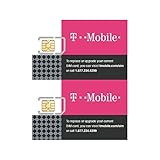
- "Triple-cut" SIM Card can be punched out for the desired size. Universal, 3-in-1 SIM.
- GSM Technology. Compatible with 3G, 4G and 4G LTE devices.
- Compatible with postpaid cellular service.
- No annual contract.
- SIM card only.
That classification answers the ownership question without requiring a separate theory about which network Metro uses: T-Mobile itself groups Metro with its own branded prepaid business. The documents reviewed here do not provide a complete acquisition narrative for Metro, so it is more accurate to describe Metro’s present place in T-Mobile’s portfolio than to attach an unsupported purchase date or transaction price.
What “flagship brand” means in this context
“Flagship” is T-Mobile’s description of a major consumer brand, not a promise that every plan, store, billing system, or support channel is identical across brands. Metro can have its own customer-facing identity and retail experience while still being part of T-Mobile’s corporate prepaid operation.
Mint Mobile: acquired through Ka’ena Corporation
Mint Mobile became part of T-Mobile through T-Mobile’s acquisition of Ka’ena Corporation. T-Mobile announced that the transaction closed on May 1, 2024, and specified that Ka’ena included Mint Mobile and Ultra Mobile. T-Mobile’s later 2025 Form 10-K continues to list Mint among its prepaid offerings and flagship brands.
Windows Errors? Fix Them Before They Spread
Repair common Windows errors and clear accumulated junk for a smoother, more stable PC - no reinstall needed.Free scan · no reinstallCrashes, No Sound, or Screen Glitches?
Random freezes, missing sound and display glitches usually trace back to one bad driver. Find and replace yours safely.Free scan · under a minuteThe closing date matters. A 2023 announcement described the proposed transaction, but a proposal is not the same as completed ownership. The May 1, 2024 closing announcement is the point at which T-Mobile said the acquisition was complete.
Independent operation does not mean independent ownership
At closing, T-Mobile said Mint and Ultra would continue operating autonomously while remaining closely aligned with the broader company. “Autonomous” in that statement describes how the brands would operate, not a separate corporate owner. A brand can retain its name, marketing approach, and day-to-day decision-making while its parent company owns the business.
Mike Katz, T-Mobile’s president of marketing, strategy and products, characterized the closing as “a perfect pairing of highly complementary brands coming together on our industry-best 5G network.” The quote describes T-Mobile’s strategic rationale; it does not turn network access into the legal test for ownership.
Rank #2

- (2) 5g TMobile Triple cut (3 in 1) size included
- (1) SimBros Sim Removal pin tool included
- For Tmobile USA Prepaid or Postpaid Service
Ultra Mobile: included in the same completed acquisition
Ultra Mobile was the second consumer prepaid wireless brand identified as part of Ka’ena. T-Mobile’s May 1, 2024 closing announcement names Ultra alongside Mint, and T-Mobile’s 2025 Form 10-K lists Ultra in its prepaid brand portfolio.
Earlier transaction materials and a May 2023 Federal Communications Commission notice reported that the applicants said Mint and Ultra operated exclusively on T-Mobile’s network. That statement is useful context about network dependence, but it is not the ownership evidence by itself. The completed acquisition announcement and T-Mobile’s subsequent filing establish the corporate relationship; the network statement establishes how service was delivered at the time described.
Why Ultra often causes confusion
People searching for carriers that “use T-Mobile” may encounter Ultra in lists that mix mobile virtual network operators, resellers, and T-Mobile-owned brands. Those lists answer a network question. Ultra belongs on an ownership list because T-Mobile says it acquired the company behind the brand, not merely because the service used T-Mobile’s radio network.
Why the fourth carrier cannot be confirmed
The title’s four-item count is not supported by the cited primary evidence. T-Mobile’s 2025 filing names T-Mobile, Metro by T-Mobile, Mint Mobile, and Ultra Mobile in its prepaid discussion, but it does not provide a fourth distinct consumer carrier beyond those three branded prepaid businesses. The Ka’ena closing announcement likewise identifies Mint and Ultra as the consumer prepaid brands acquired in that deal.
It would be misleading to fill the missing slot with a brand that merely uses T-Mobile’s network, appears in an old list, or is connected to a different type of telecommunications transaction. The same announcement describes another Ka’ena business as a wholesale wireless solutions provider rather than a fourth consumer prepaid carrier. Wholesale infrastructure and consumer service brands should not be counted as interchangeable carriers.
How to read an unresolved count
- Do not infer ownership from a coverage map. Coverage shows whose towers or spectrum provide service, not who owns the retail brand.
- Do not treat a proposed deal as a completed deal. The 2023 announcement preceded the May 2024 closing.
- Do not count a wholesale provider as a consumer carrier. The businesses serve different roles in the communications market.
- Do not assume a fourth name because a headline says four. The number must be verified against a current filing or closing document.
Network access versus corporate control
A wireless brand can reach customers through another company’s network under a wholesale or mobile-virtual-network arrangement. In that situation, the network operator supplies some combination of radio access, spectrum, roaming, or other infrastructure, while the retail brand handles its own marketing, plans, billing, or support. The arrangement can change without the retail company being acquired.
Rank #3

- True Unlimited High-Speed Data at 4G/LTE speed on T-Mobile Network in USA.
- Unlimited calls within the USA, International texting and personal hotspot at 3G speed.
- Calls, texting, and data can also be used in the USA, Canada and Mexico.
- The activation takes up to 2 Hours.
Ownership is a corporate question: which legal company controls the brand or the operating company behind it? For this topic, the strongest evidence is T-Mobile’s own filing and its acquisition-closing announcement. A statement that a brand “runs on” T-Mobile can support a network-use claim, but it cannot, by itself, support an ownership claim.
This distinction is especially important when comparing prepaid options. Two brands may use the same underlying network yet have different plan rules, data policies, international features, retail channels, or customer-support processes. Conversely, brands owned by the same parent may continue to operate with separate customer-facing policies.
Timeline of the evidence
- March 15, 2023: T-Mobile announced the proposed Ka’ena transaction and described Mint and Ultra as complementary to its existing prepaid offerings, including Metro by T-Mobile, T-Mobile-branded prepaid service, and Connect by T-Mobile.
- May 2023: An FCC notice related to the proposed transaction reported the applicants’ statement that Mint and Ultra operated exclusively on T-Mobile’s network. This was network context during the review period, not a substitute for a closing notice.
- May 1, 2024: T-Mobile announced that it had completed the Ka’ena acquisition, including Mint Mobile and Ultra Mobile. T-Mobile said the two brands would continue operating autonomously while remaining closely aligned with the larger company.
- 2025 Form 10-K, filed in 2026: T-Mobile listed T-Mobile, Metro by T-Mobile, Mint Mobile, and Ultra Mobile in its prepaid business and identified T-Mobile, Metro, and Mint as flagship brands.
Because ownership can change, the latest annual filing or a newer transaction announcement should take priority over older listicles and search snippets when you revisit this question.
What this means if you are choosing a prepaid service
Ownership alone does not establish which brand is the best value or has the best experience. The documents establishing ownership do not provide a current, apples-to-apples comparison of plan prices, high-speed data allowances, throttling, hotspot limits, international calling or roaming, network priority, coverage in a particular location, or support access.
Check those details on the current official plan pages before switching. Compare the same payment term and account size, because a monthly price can change with taxes, autopay conditions, multi-line discounts, or a one-time promotion. A promotional price mentioned in an older transaction announcement should not be treated as a current plan price.
A practical comparison checklist
- Monthly or annual payment requirement and the total amount after taxes and fees.
- High-speed data included before any reduced-speed policy applies.
- Hotspot allowance and whether hotspot traffic is subject to a separate cap.
- Domestic coverage where you live, work, and travel, including indoor performance.
- Network-priority terms during congestion, if the plan discloses them.
- International calling, texting, roaming, and travel data rules for the countries you use.
- Number-porting requirements, eSIM or physical-SIM support, and device compatibility.
- Customer-service hours, retail-store availability, and the process for replacing a lost SIM.
How to verify ownership when a list claims there are four
You can test a future ownership claim without relying on a headline. Use a short source-checking process:
- Find the newest parent-company filing. Search the company’s investor-relations site or regulatory filing index for the latest annual report. Read the sections covering brands, prepaid service, subsidiaries, and acquisitions.
- Look for a closing announcement. A proposed purchase announcement shows intent; a closing release states whether the transaction actually completed and which businesses were included.
- Identify the legal entity. Confirm that the document names the company owning the brand, rather than only naming a network provider, distributor, or wholesale partner.
- Separate consumer brands from infrastructure businesses. A wholesale provider, tower company, or software supplier is not automatically another phone carrier for a consumer list.
- Attach dates to every conclusion. Ownership and brand portfolios change. Record the filing year and transaction-closing date beside the claim you publish.
Common mistakes in “carriers owned by T-Mobile” lists
Mistake 1: treating the network as the owner
Network access can be purchased or provided under a commercial agreement. It is evidence about service delivery, not proof of corporate control.
Do these 3 things before closing this tab:
1Scan for outdated or missing drivers - takes under a minute2Clear out junk files and repair common Windows errors3Fix the driver behind crashes, sound loss and screen glitchesMistake 2: using an announcement date as a closing date
The Ka’ena deal was announced in 2023 and completed on May 1, 2024. Those dates answer different questions and should not be collapsed into one.
Mistake 3: counting brands and legal companies inconsistently
A list may count a brand in one row, a parent company in another, and a wholesale business as a third. A credible comparison must use the same unit—distinct consumer carrier brands—throughout.
Mistake 4: assuming autonomous operation means separate ownership
T-Mobile’s statement that Mint and Ultra would operate autonomously describes their operating model after the acquisition. It does not negate the completed change in ownership.
Bottom line on the four-carrier claim
The evidence supports three T-Mobile-owned prepaid carrier brands: Metro by T-Mobile, Mint Mobile, and Ultra Mobile. Metro is part of T-Mobile’s established prepaid portfolio; Mint and Ultra joined through the completed Ka’ena acquisition on May 1, 2024. A fourth distinct consumer carrier is not verified by the available primary sources, so the responsible answer is to correct the count rather than guess.
Recommended Free Tools
Quick Recap
Product prices and availability are accurate as of the date/time indicated and are subject to change. Any price and availability information displayed on Amazon at the time of purchase will apply.

