
iTechGuides is reader-supported. When you buy through links on our site, we may earn an affiliate commission. As an Amazon Associate I earn from qualifying purchases. Learn more
For most air travelers, a 20,000mAh-class power bank is the better default when portability matters. A 27,000mAh-class model is worthwhile when you need more reserve energy and accept a larger, potentially heavier unit. The deciding number at an airport is not the rounded mAh label: check the exact model’s watt-hour (Wh) marking, then apply every airline’s rules for your itinerary.
What the mAh number actually tells you
Milliamp-hours (mAh) describe charge capacity at a stated battery voltage. Watt-hours (Wh) express energy, which is the unit used for airline battery limits. The Federal Aviation Administration (FAA) gives the conversion as: multiply volts (V) by amp-hours (Ah), and divide mAh by 1,000 to convert it to Ah.
In formula form, Wh = V × Ah, and Ah = mAh ÷ 1,000. For a hypothetical label of 20,000mAh at 3.7V, that calculation would be 3.7 × 20 = 74Wh. The voltage printed by the manufacturer is essential; do not substitute a guessed voltage for the model’s documented rating.
Two power banks with similar mAh labels can therefore have different Wh ratings if their internal battery voltage or design differs. Labels are also often rounded, so a product marketed as “20,000mAh” may list 20,100mAh, while a “27,000mAh” product may actually be 27,650mAh. Use the Wh printed on the device, packaging, or manufacturer specification rather than estimating from the class name.
#1 Best Overall
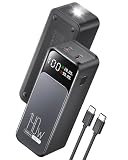
- This laptop power bank has a capacity of 27000 mAh and adopts a high-density battery design. Its extremely long battery life enables you to get rid of the anxiety and worry about running out of power for your devices at any time and anywhere.
- The intelligent digital display on this laptop power bank can show the current output/input power in real time and estimate the charging time, allowing you to keep track of the device status at any time and be well-prepared.
- Convenient & Airline Approved: Get through TSA and boardyour flight on time with this 99.9Wh laptop battery power bank that meets boarding standards(Below 100Wh). This laptop portable charger is the size of a soda can. Making it a perfect choice for light travel or commuting. (size: 6.41 x 2.04 x 2.28 inches, weight: 1.38 pounds).
- Smart LED Display & Super bright flashlight: The smart digital display on this laptop portable charger provides real-time insights on output/input power and estimates the recharge time, keeping users informed and their devices ready. This laptop powerbank is also equipped with a super bright flashlight. With 4 modes, it can help you light up the darkness. Perfect companion for power outages, night walks, reading and emergencies.
- Wide Compatibility: This power bank supports power 1,000+ devices from big to small. Whether you have an Android, Apple, or another brand of device, this charger's got you covered. A universal solution for all your charging needs.
Nominal capacity is not the same as energy delivered to a phone. The bank’s voltage-conversion circuitry, charging protocol, cable, and the device’s own charging system introduce losses. A 27,000mAh label does not promise 35% more usable phone runtime than a 20,000mAh label, even though the nominal mAh difference is about that size.
Capacity is only one part of a power bank’s usefulness. Charging output, USB-C support, port count, recharge input, dimensions, weight, and compatibility with your devices determine whether the stored energy is practical on a trip. A larger mAh figure does not automatically mean faster charging or better compatibility.
Airline rules come before capacity preferences
Under current US passenger guidance, a power bank is treated as a spare lithium-ion battery. The FAA states: “Spare lithium batteries (including power banks and portable chargers) must be carried on and cannot be checked.” Keep the power bank in cabin baggage, never in checked luggage.
The FAA’s ordinary limit is up to 100Wh per lithium-ion spare battery. Batteries rated from 101Wh through 160Wh require airline approval, and no more than two spare batteries in that range may be carried. Airlines can impose stricter limits, and the FAA notes that TSA, individual carriers, and international authorities may have additional requirements. The guidance is based on US Department of Transportation rules and is not a universal guarantee for every country or airline.
The 100Wh figure is a per-battery threshold, not a statement that you may combine several banks to create an unrestricted total. Each power bank must be assessed on its own marking and under the carrier’s policy. Approval for a 101–160Wh battery is not automatic simply because the battery is below 160Wh.
How to check a power bank before buying
- Identify the exact model. Record the complete model number, not just a family name such as “20K” or “27K.” Different revisions and regional listings can have different ratings.
- Find the Wh rating. Look on the casing, specification sheet, manual, or manufacturer FAQ. If both mAh and Wh are printed, use the stated Wh value.
- Compare with the airline threshold. Up to 100Wh falls under the FAA’s ordinary limit; 101–160Wh needs the airline’s approval. Do not assume approval is available or automatic.
- Check every carrier. Review the baggage pages for each airline on your itinerary, including codeshare segments and return flights. A connecting airline may apply a different policy.
- Confirm country-specific rules. The FAA guidance applies to US passenger travel. International authorities and airports may publish additional restrictions.
- Pack it in the cabin. Put the power bank in your carry-on and follow the airline’s instructions about access, protection, and use during the flight.
- Keep proof available. Save the product page or manual showing the Wh value and the relevant carrier policy so you can answer questions at check-in or security.
20,000mAh versus 27,000mAh at a glance
| Consideration | 20,000mAh class | 27,000mAh class |
|---|---|---|
| Nominal capacity | Lower stored capacity than the larger class, all else equal. | Higher nominal capacity than the smaller class, all else equal; the label represents roughly 35% more mAh than 20,000mAh, but delivered energy depends on voltage and conversion losses. |
| Flight-rule check | Read the exact model’s Wh marking. The class name alone does not establish eligibility. | Apply the same check. A cited 27,650mAh model is listed at 99.54Wh, but other models can have different ratings. |
| Portability | A specific 20K example weighs 510g and measures 44 × 50 × 147mm. Other models vary. | Expect to compare the actual unit carefully. The cited 27,650mAh model is approximately 162 × 57 × 50mm; its weight was not stated on the referenced listing. |
| Best fit | Travelers who want a smaller or lighter specific model and a moderate reserve. | Travelers who need more reserve energy and accept the particular model’s dimensions and weight. |
| Other buying checks | USB-C output, port count, recharge input, cable requirements, and device compatibility. | The same checks. Capacity alone does not tell you charging speed or compatibility. |
On the nominal labels alone, 27,000mAh offers more reserve. In a bag, however, the trade-off is not simply “more is better.” You are carrying the cells, housing, electronics, and cables required to deliver that energy. A physically efficient 27K design might compare favorably with a bulky 20K design, while another 27K unit may be uncomfortable in a small personal item.
This is a directional comparison, not a claim that every 20,000mAh bank is smaller or lighter than every 27,000mAh bank. Product construction varies enough that the exact model’s specification sheet should decide the purchase.
Quick wins for a faster PC:
Fix the driver behind crashes, sound loss and screen glitchesFind Drivers →Clear out junk files and repair common Windows errorsFree Scan →Scan for outdated or missing drivers - takes under a minuteDriver Scan →Real product examples show why model-level checking matters
| Specification | 20K example | 27,650mAh example |
|---|---|---|
| Model and source | Anker Prime Power Bank (20K, 220W) | Anker Prime Power Bank (27650mAh, 250W) |
| Rated capacity | 20,100mAh | 27,650mAh |
| Wh rating | Not stated in the cited product specification; check the unit or current documentation before flying. | 99.54Wh, according to the manufacturer’s FAQ. |
| Dimensions | 44 × 50 × 147mm | Approximately 162 × 57 × 50mm |
| Weight | 510g | Not stated on the cited listing. |
| Output designation | 220W maximum total output | The product designation states 250W; verify the live specification for the ports and operating limits you need. |
The 99.54Wh figure places that particular 27,650mAh model below the FAA’s 100Wh ordinary threshold. It is a product-specific manufacturer statement, not evidence that every power bank marketed around 27,000mAh is below 100Wh. Conversely, a 20,000mAh label does not remove the need to read the exact Wh marking.
Notice also what the table does not establish. The 220W and 250W designations are maximum total-output claims, not a promise that one USB-C port can deliver that amount in every combination of connected devices. The 27,650mAh listing does not provide a weight in the cited specification, so it would be misleading to call it lighter or heavier than the 20K example.
When a 20,000mAh bank is the better travel choice
Choose it for a lighter everyday carry
If your main goal is to keep a phone, earbuds, tablet, or similar devices running through a normal travel day, the 20,000mAh class generally offers a sensible balance between reserve and bulk. The cited 20K example is 510g, so it is already substantial in a small personal bag; a differently designed 20K model may weigh more or less.
Weight becomes noticeable when you carry the bank alongside a camera, water bottle, laptop, and travel documents. A capacity that covers your realistic day is often more comfortable than carrying maximum reserve that remains unused. Check the complete packed weight of your personal item, not just the bank’s advertised net weight.
Choose it when space matters more than maximum reserve
On trips involving frequent walking, public transport, or a small daypack, dimensions can matter as much as capacity. A shorter or narrower unit is easier to place beside a passport, camera, or cables. Compare the manufacturer’s measurements rather than assuming all 20K products share one shape.
Measure the pocket or organizer where you intend to keep the bank. A few millimeters can determine whether the cable can remain attached without bending, whether the zipper closes, and whether the bank is easy to retrieve for inspection.
Rank #2

- 30% Smaller, Effortlessly Portable: Leveraging industry-first TinyCell high-density battery technology, we’ve shrunk 20,000mAh into a frame 30% smaller than other power banks of the same capacity. At just 11.5oz—the weight of a 330ml can of cola, it slides effortlessly into your crossbody bag.
- 15 mins Faster with 45W Charging: Stop waiting and start exploring. Our 45W output is 15 minutes faster than traditional 22.5W power banks, boosting an iPhone 17 Pro from 20% to 76% in just 30 minutes—exactly the time it takes to finish an espresso.
- 2-Day Power, Zero Battery Anxiety: With a massive TSA-compliant 20,000mAh capacity, this power bank fuels your journey with about 4 full charges for phones or 2 full charges for tablets. From morning commutes to weekend getaways, stay powered and connected without ever being tethered to a wall.
- Simplify Your Carry: Never forget your cable again with the built-in braided USB-C cable. Tested for 10,000+ bends, it eliminates tangled wires in your bag. Plus, a built-in flashlight adds extra peace of mind for emergencies.
- Charge 3 Devices at Once: Low on battery? Charge up to 3 devices simultaneously—your phone, tablet, and more.
Choose it when you want a simpler airline comparison
A 20,000mAh-class product is not automatically under 100Wh, but many are designed around that travel-friendly range. You still need the printed Wh value and carrier confirmation. The practical advantage is that you are usually comparing against a lower-capacity class instead of seeking the maximum energy that may approach an airline threshold.
When a 27,000mAh bank earns its extra size
Choose it for longer gaps between outlets
The larger class makes sense when you expect long rail journeys, remote work days, camping, photography, or several consecutive days without reliable wall power. The additional nominal capacity gives you more reserve, provided the model’s output and your devices match your needs.
Do these 3 things before closing this tab:
1Repair Windows errors before they cause bigger problems2Fix the driver behind crashes, sound loss and screen glitches3Clear out junk files and repair common Windows errorsIt can also reduce how often you stop to recharge the bank itself. That convenience matters on itineraries where a wall socket is shared, occupied, or unavailable. It does not eliminate the need to recharge eventually, and the larger bank may take longer to refill depending on its input rating and wall charger.
Choose it for several devices, not just one phone
A phone, tablet, headphones, camera batteries, and a handheld game system can consume a reserve quickly. A 27,000mAh-class bank reduces the frequency of recharging the bank itself. It does not guarantee a particular number of device charges because device battery sizes, charging protocols, cable losses, and the bank’s conversion efficiency differ.
List the devices you will actually carry and identify which ones may be charged simultaneously. A larger capacity is useful only if the bank has enough suitable ports and can share output in the way your devices require.
Accept the dimensions and verify the weight
The cited 27,650mAh model measures approximately 162 × 57 × 50mm, longer and thicker in one dimension than the cited 20K example. The referenced listing does not state its weight, so obtain that figure before committing to a carry-on allowance or a day of walking. Never substitute the weight of a related model.
Do not infer that a larger capacity automatically violates cabin rules. The cited 27,650mAh model is listed at 99.54Wh, just below the FAA’s ordinary 100Wh threshold. Do not infer the opposite either: another 27K product may have a different voltage, rating, or labeling.
Capacity does not determine charging speed
Look separately at maximum output, USB-C Power Delivery support, the number and type of ports, and how the bank recharges. The cited 20K example advertises 220W maximum total output, but that headline figure does not tell you how much power one port can supply while others are in use. Check the per-port table and simultaneous-output rules in the current manual.
The 27,650mAh example is sold under a 250W designation. Treat that as a model-specific specification and verify the live port limits, supported charging standards, and input power. A high total-output number is useful only if your laptop, phone, tablet, or camera accepts the corresponding protocol and the supplied cables can carry it.
- Confirm that at least one port matches your device’s connector and charging standard.
- Check the maximum single-port output, not only the combined maximum.
- Check whether output is reduced when two or more devices are connected.
- Verify the bank’s own recharge input and the wall charger needed to refill it efficiently.
- Include cable length, connector type, and any adapters in your travel plan.
- Check whether your laptop or tablet requires a particular USB-C Power Delivery profile rather than merely a USB-C-shaped connector.
Port compatibility is especially important when capacity is close between candidates. A smaller bank with the right USB-C output may be more useful than a larger bank that charges your main device slowly or cannot power it while you work.
Free tools Windows power users keep installed
One-click scans. No signup required.
How much capacity do you really need?
Start with the itinerary rather than a target number. One phone used for navigation and occasional photos has a different requirement from a phone, tablet, camera, laptop, and headphones used over a weekend without outlets. Count the charging events you expect, then allow for conversion losses and the possibility that you cannot recharge the bank when planned.
For a routine city day, a 20,000mAh-class bank is often a reasonable starting point because it provides reserve without targeting the largest travel-legal capacity. For remote work, multi-device travel, or repeated long transfers, the extra nominal capacity of a 27,000mAh-class model can justify its footprint. These are starting points, not guaranteed charge counts.
Consider recharge opportunities as well as consumption. If you can refill the bank overnight or at a station, carrying less may be sensible. If your schedule includes several consecutive outlet-free periods, the larger class provides more margin. Your decision should reflect the complete route, not only the longest flight.
Rank #3

- 27000mAh High Capacity & Flight-Approved: This portable charger with a powerful 27000mAh (99.9Wh) battery, allowing you to bring it on planes safely. Keep all your devices powered for days on extended trips, outdoor adventures, or during busy workdays without searching for outlets.
- 140W Two-Way Fast Charging: Experience lightning-fast charging for both the Laptop Power Bank and your devices. The USB-C1 port supports 140W input/output (PD 3.1), fully recharging this massive power bank in about 1 hours and quickly powering compatible laptops like MacBook Pro, tablets, and smartphones.(Note: Use a 5A cable and a 140W charger.)
- Charge 3 Devices at Once & Smart Display: The smart digital screen clearly shows remaining power and input/output wattage. When using all three ports together, the power bank intelligently distributes power up to 100W (USB-C1) + 15W (USB-C2+USB-A), ensuring all your essential devices stay powered without carrying multiple chargers.
- Wide Compatibility & Safe Charging for All Devices: USB-C1 Port Supports PD3.1, QC3.0, AFC, FCP, and Apple 2.4A protocols across its ports, making it universally compatible with iPhone 17/16 series, Samsung Galaxy S25, iPad, MacBook,Laptop, cameras and more.
- Premium Durable Build & Portable Design: Built with premium PC and aluminum alloy for superior heat dissipation, drop resistance and safety. This portable charger Size:6.5×2.16×1.96 in and weighs only 1.4Lbs(636g),fits perfectly in car cup holders, backpack side pockets, or luggage. It’s the perfect blend of massive power and everyday carry convenience.
A purchase checklist for either capacity class
- Write down your devices. Include phones, tablets, laptops, cameras, watches, and wireless accessories you expect to charge.
- Estimate your reserve need qualitatively. A normal day with one phone favors portability; multiple high-drain devices or several days away from outlets favor the larger class.
- Compare exact Wh, weight, and dimensions. Record these three values for each candidate. If a value is not published, contact the manufacturer or choose a model with clearer documentation.
- Check output compatibility. Match USB-C and other ports, single-port wattage, charging protocols, and simultaneous-use limits to your equipment.
- Check recharge performance. A high-capacity bank can be inconvenient if its input is slow or your wall charger cannot supply the required power.
- Validate the itinerary. Apply the FAA baseline for US travel, then read every airline’s current policy and any destination-country requirements.
- Save the documentation. Keep a screenshot or PDF of the model’s Wh specification and the carrier rule in case an agent asks at check-in or security.
- Pack for cabin transport. Carry the power bank in hand luggage and keep it accessible if the airline requires inspection.
- Recheck volatile details. Product pages, regional specifications, and airline rules can change, so confirm the live listing and policy for your travel date.
Common mistakes and how to avoid them
Using mAh as if it were the airline limit
Airline thresholds are expressed in Wh. A rounded 27,000mAh label cannot prove that a product is over or under 100Wh. Read the manufacturer’s Wh marking or calculate it from the stated voltage and amp-hours using the FAA method.
PC Slower Than It Used to Be?
A free scan shows the junk files, broken settings and background clutter dragging Windows down - then fixes them in one click.Free scan · Windows 10 & 11Outdated Drivers Are Slowing You Down
One free scan finds every outdated or missing driver and matches the right update for your exact hardware.Free scan · exact hardware matchAssuming every 27K product matches the 99.54Wh example
The 99.54Wh value belongs to one 27,650mAh model. Cell voltage, configuration, and labeling can differ across products. Treat it as an example, not a class-wide certification.
Confusing a product family with one specification
Names such as “20K” or “Prime” can cover several revisions and regional listings. Match the model number, capacity, Wh rating, dimensions, weight, and output to the exact item in your cart.
Comparing headline output instead of usable ports
A 220W or 250W total-output designation does not describe every port’s behavior. Read the single-port maximum and the reduced limits that may apply when several devices are connected.
Ignoring the bank’s own recharge time
The larger class stores more energy, but that energy still has to be replenished. Check input power, required charger, and whether your travel routine provides enough time to refill it.
What’s actually slowing this PC down?
Pick the symptom - the matching free tool is one click away.
Checking only the outbound airline
A return flight, codeshare, or connection may be governed by another carrier. Review the complete itinerary before packing, and recheck policies close to departure because airline rules can change.
Putting a power bank in checked luggage
The FAA’s passenger guidance requires spare lithium batteries, including power banks, to travel in the cabin. Move the unit to your carry-on before checking a suitcase.
Relying on a retailer’s rounded title
Marketplace titles may say “20K” or “27K” while the specification belongs to a different revision. Use the manufacturer’s exact model documentation and confirm that the model number in the listing matches the product you receive.
Independent reader supportYour contribution helps us test, update, and keep practical guides available for everyone.Decision guide
| Your priority | More suitable starting point | What to verify |
|---|---|---|
| Smallest practical daily carry | 20,000mAh class | Exact weight, dimensions, Wh, and a port that meets your device’s needs. |
| Several devices or long outlet-free periods | 27,000mAh class | Exact Wh, actual weight, dimensions, output sharing, and airline approval requirements. |
| Strict or uncertain airline itinerary | The model with the clearest Wh marking and carrier confirmation | Every airline’s policy; do not rely on the mAh class or a retailer headline. |
| Fast laptop or tablet charging | Either class, depending on the device | Single-port USB-C output, charging protocol, cable rating, and simultaneous-output behavior. |
| Frequent access to wall power | 20,000mAh class unless your devices demand more | Weight, dimensions, recharge input, and whether the smaller reserve covers your longest gap. |
| Several days with uncertain outlet access | 27,000mAh class if the model is permitted | Wh marking, carrier rules, actual weight, and the time required to recharge. |
Frequently asked questions
Is a 27,000mAh power bank allowed on a plane?
It depends on the exact model’s Wh rating and the airline. The cited Anker 27,650mAh model is listed at 99.54Wh, below the FAA’s ordinary 100Wh threshold. That does not certify every product sold around 27,000mAh. Check the printed Wh value and every airline’s current rules.
The Tool Desk
Outbyte PC Repair FREERepair Windows errors before they cause bigger problemsFix Now →Outbyte Driver Updater FREEFix the driver behind crashes, sound loss and screen glitchesFind Drivers →Is 20,000mAh automatically under 100Wh?
No. The mAh class alone is not the airline measurement. Read the exact model’s Wh marking or calculate Wh from the documented voltage and amp-hours.
Can I put either capacity in checked baggage?
No under the FAA passenger guidance: spare lithium-ion batteries, including power banks, must be carried on and cannot be checked. Put the unit in cabin baggage and follow the carrier’s handling instructions.
Does 27,000mAh charge devices faster?
No. Capacity and charging speed are separate specifications. Compare USB-C Power Delivery support, maximum single-port output, port sharing, cable requirements, and device compatibility.
Which is better for a phone-only trip?
A 20,000mAh-class bank is usually the more practical starting point when you value a moderate reserve and easier carrying. Confirm that the exact model’s weight, dimensions, Wh, and output suit your itinerary.
Recommended Free Tools
Rank #4

- Triple 100W USB-C Ports for Multi-Device Charging: Ideal for laptop users, this 25,000mAh power bank features three 100W USB-C ports for simultaneous charging—perfect for remote work, home offices, or powering up multiple devices on the go.
- 25,000mAh for Long-Haul Power: Tackle week-long trips or extended camping with 25,000mAh capacity and ultra-fast recharge speeds for the power bank when used with a 100W or higher charger. (Note: Complies with 100Wh airline restrictions and is airline carry-on friendly.)
- Dual Built-In Cables for Travel: Features two USB-C cables, one extendable up to 2.3 ft with 20,000 retractions, and another at 0.98 ft cable that doubles as a durable carrying strap capable of enduring more than 20,000 bends. Built to handle family travel, outdoor activities, and emergency backup needs.
- Charge 4 Devices at Once: Power up smartphones, tablets, or other USB-enabled devices thanks to dual USB-C cables, a USB-A port, and a USB-C port.
- What You Get: Anker Power Bank (25K, 165W, Built-In and Retractable Cables), protective pouch, user manual, 18-month warranty, and our friendly customer service. (Note: Charger shown in the video is not included.)
When is the larger class worth carrying?
Choose a 27,000mAh-class model when you expect several devices, long outlet-free periods, remote work, camping, photography, or repeated travel days without reliable wall power. Verify its actual weight and dimensions before buying.
What if the manufacturer does not publish Wh?
Look on the casing, manual, packaging, or manufacturer FAQ. If the value remains unavailable, contact the manufacturer or choose a model with clearer documentation rather than relying on a rounded mAh label.
Do airline rules apply to each airline on a connection?
Review every carrier, including codeshare and return segments. A connecting or operating airline may have stricter requirements than the carrier that sold the ticket.
Bottom line
Start with a 20,000mAh-class bank if portability and a moderate reserve are your priorities. Move to a 27,000mAh-class model when the extra energy justifies its larger footprint and you have confirmed its weight, Wh rating, ports, and output. For air travel, the non-negotiable checks are the exact Wh marking, cabin-only packing, and the rules of every airline on your route. The cited 27,650mAh model at 99.54Wh demonstrates that one product in the larger class can fall below 100Wh, but only the exact model’s documentation and your carrier’s current policy establish whether you can fly with it.
Frequently Asked Questions
Is a 27,000mAh power bank allowed on a plane?
It depends on the exact model’s Wh rating and the airline. The cited Anker 27,650mAh model is listed at 99.54Wh, below the FAA’s ordinary 100Wh threshold, but other products can differ.
Is 20,000mAh automatically under 100Wh?
No. Check the model’s printed Wh value or calculate it from the documented voltage and amp-hours.
Can I pack a power bank in checked baggage?
No under FAA passenger guidance. Power banks are spare lithium-ion batteries and must travel in the cabin.
Does a larger mAh rating mean faster charging?
No. Compare USB-C output, charging protocols, port sharing, cable requirements, and device compatibility separately.
The Tool Desk
Outbyte PC Repair FREERepair Windows errors before they cause bigger problemsFix Now →Outbyte Driver Updater FREEScan for outdated or missing drivers - takes under a minuteDriver Scan →Which capacity is better for a phone-only trip?
A 20,000mAh-class model is generally the more portable starting point, subject to its exact weight, dimensions, Wh rating, and output.
When should I choose 27,000mAh?
Consider it for several devices, long outlet-free periods, remote work, camping, photography, or multiple travel days without reliable wall power.
What should I do if Wh is not listed?
Check the casing, manual, packaging, or manufacturer FAQ, or contact the manufacturer. Do not rely only on a rounded mAh label.
Do I need to check every airline on a connecting itinerary?
Yes. Review each operating carrier, codeshare segment, return flight, and applicable destination-country requirements.
What’s actually slowing this PC down?
Pick the symptom - the matching free tool is one click away.
The Bottom Line
Bottom line: Choose 20,000mAh for a more portable everyday travel reserve; choose 27,000mAh when extra energy outweighs added bulk. For either class, verify the exact Wh marking, cabin-only packing, airline rules, weight, dimensions, ports, and output.
Quick Recap
Product prices and availability are accurate as of the date/time indicated and are subject to change. Any price and availability information displayed on Amazon at the time of purchase will apply.

