
iTechGuides is reader-supported. When you buy through links on our site, we may earn an affiliate commission. As an Amazon Associate I earn from qualifying purchases. Learn more
Life on Earth mostly shares the same 20-amino-acid protein alphabet because organisms inherited a genetic code from common ancestors, and changing that code became increasingly costly. Why those particular 20 became standard is a separate question, and it remains unresolved. Prebiotic chemistry, evolving metabolism, protein chemistry and historical chance may all have contributed; no single explanation accounts conclusively for the exact set.
How the genetic code uses amino acids
When a cell builds a protein, it reads messenger RNA in groups of three nucleotide letters. Each three-letter group is a codon: most codons specify an amino acid, while others signal that translation should stop.
There are 64 possible codons but only 20 standard amino acids. As a result, several different codons can specify the same amino acid. The arrangement is shared by nearly all cellular life, though it is not identical in every organism or organelle. Molecular Biology of the Cell describes the codon system and its redundancy.
Why is the code shared across life?
The strongest explanation is common ancestry: early cellular life used a translation system, and its descendants inherited it. The standard genetic code is “virtually universal among extant life forms,” as Koonin and Novozhilov put it in their 2017 review, Origin and Evolution of the Universal Genetic Code.
#1 Best Overall

- FOR BASIC TEACHING TO ADVANCED SCIENCE: 444 pieces molecular model kit, including 136 atoms, 158 bonds and 150 parts for Carbon-60(Fullerene), provides to students from Grade 7 to Graduate level.
- TWO CHEMICAL STRUCTURE MODELS: The ball-and-stick models use spheres to represent atoms and sticks to represent chemical bonds. In the space-filling model, the spheres are drawn to scale and are next to one another as atoms are in real molecules.
- CHEMISTRY EDUCATIONAL MOLECULE MODEL IN 3D: It can display chemical structure, molecular bond, and bond angle in all directions. Demonstrate fundamental molecular geometry, chemical molecular structure, stereochemistry with 3D modeling studies.
- EASY TO LEARN: The universal standard adopted for each atom's color makes it easier for you to use and learn. Atoms and chemical bonds combine tightly and firmly and can be easily disassembled by disconnecting tools.
- If you’re not in love with it for whatever reason, we’ll give you a full replacement or refund—no questions asked. If you have any doubt, please tell us. With nothing to worry about, or even to share with your friends, try it now.
Once many genes and proteins depend on a code, changing what a codon means can alter numerous proteins at once. A reassignment could also make it harder for organisms to exchange genes: a sequence that specifies one amino acid in one organism might be read as another in a recipient with a different code. These costs help explain why an inherited system stayed broadly stable. They do not explain why its original assignments used these particular amino acids.
The code also has a degree of error tolerance: codons that differ by one nucleotide often specify the same or chemically similar amino acids. That feature is not proof that the code was deliberately designed or optimized from the outset. Koonin and Novozhilov argue that error minimization may have emerged as a by-product of early code expansion rather than being its direct goal.
Why these 20 amino acids?
Common ancestry helps explain why organisms share the alphabet, not how the alphabet was first assembled. Several ideas address that origin, and they may complement one another. The evidence does not establish a definitive entry order or a complete explanation for every amino acid in the standard set.
Quick wins for a faster PC:
Fix the driver behind crashes, sound loss and screen glitchesFind Drivers →Repair Windows errors before they cause bigger problemsFix Now →Rank #2
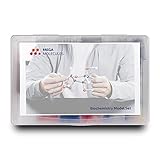
- Perfect for Visual Learners - This hands-on Biochemistry Model Kit is a tool that doesn’t just show you molecular structures; it lets you explore the magic of bonding, resonance, and chemical interactions like never before. It’s your key to understanding how molecular 3D structures influence chemical properties, such as in nucleotides and their base pairs, or in lipids and their hydrophobic behavior. You'll connect the dots between a compound's physical and chemical properties and its three-dimensional structure, deepening your understanding and making complex concepts intuitive.
- Versatile & Suitable for All Learning Levels - Whether you're a biochemistry student, an educator, or just passionate about molecular science, this model set will elevate your learning experience. It’s a powerful way to transform abstract molecular diagrams into tangible, interactive models you can touch, build, and explore. Get ready to turn curiosity into mastery—because biochemistry isn't just a subject, it's the science of life itself. With the Biochemistry Model Set, the possibilities are endless. Don’t just learn it—build it, see it, and truly understand it!
- High-Quality, Durable Components - Components are color-coded to international standards, with scaled bond lengths for accuracy. Rigid bonds allow easy single-bond rotation, while flexible bonds are ideal for double and triple bonds. Lost parts? No problem—Mega Molecules offers replacement atoms and bonds to keep your kit complete and long-lasting.
- Easy Assembly & Disassembly - Unlike many competitor kits that require special tools and make loud popping sounds during assembly or disassembly, Mega Molecules Model Sets offer a quiet, hassle-free experience. Atoms and bonds connect with a gentle push-and-twist motion and easily disconnect with a pull-and-twist—no noise, no tools needed. This thoughtful design minimizes distractions, making it perfect for classrooms, study sessions, and testing environments, ensuring a smooth, focused learning experience.
- Satisfaction Guarantee - Backed by a refund or replacement policy, this biochemistry building set offers a risk-free investment in chemistry education. Whether you're studying the protein structure, the base pairing in DNA, or the intricacies of a glycosidic linkage, this set brings your biochemistry lessons to life. Use it to model the relationships between carbon, hydrogen, oxygen, nitrogen, phosphorus, and sulfur as they form covalent bonds. With every build, you’ll gain deeper insights into the connections between molecular structure and function.
Prebiotic chemistry supplied some possibilities
Amino acids can form without life, and they have been found in meteorites. Such sources could have provided building blocks for early peptides and proteins. But availability alone is a weak explanation for the standard alphabet: the relationship between likely prebiotic abundance and which amino acids are encoded is not strong. Some amino acids in the standard set were not observed in the prebiotic synthesis or meteorite examples discussed by Knight, Freeland and Landweber in their 2006 review, On the evolution of the standard amino-acid alphabet.
That review estimated that about 80 amino acids were probably produced by abiotic synthesis before life evolved. This is the authors’ estimate, not a definitive inventory of all prebiotic chemistry.
Metabolism may have expanded the alphabet
One proposal, often called the coevolution theory, is that the genetic code expanded as organisms developed metabolic pathways that made new amino acids. An initial set could have been supplemented by products of evolving biosynthesis. This provides a possible link between metabolism and code expansion, but proposed sequences rely on assumptions about early life. Modern organisms also make many amino acids that are not directly encoded, so biosynthesis alone does not explain why the standard alphabet settled on this set.
Rank #3

- Visualize Molecular: The molecular model kit simplifies complex chemistry concepts into tangible 3D structures improve learning efficiency, suitable for students from Grade 7 to Graduate level.
- 240 Pcs Complete Set: The atom model kit includes with 86 atoms and 154 bonds, explore most the molecules structures from simple compounds to complex polymers.
- Effortless Assembly: Embedded component design ensures easy to construct Ball-and-stick and Space-filling models that maximizes focus on exploration without complex assembly.
- Durable & Portable: Built to last, the chemistry set is crafted from high-quality materials. Plus, its portable design allows you to take your experiments learning anywhere, between the home, classroom and lab.
- Essential Study Tool: Whether you're studying organic chemistry, biochemistry, or molecular biology, molecule building kit is an perfect learning tool for you deeper comprehension of molecular science.
Knight, Freeland and Landweber cite about 900 amino acids produced by natural biosynthetic pathways. That figure illustrates the breadth of biochemical possibilities beyond the standard coded set; it is not a count of amino acids encoded in proteins.
Protein chemistry made the set useful, not inevitable
The 20 standard amino acids offer a range of side-chain properties that proteins can use to fold, bind and catalyze reactions. That makes the set chemically useful, but it does not show that evolution selected a uniquely optimal alphabet. Some standard amino acids have similar properties, and proteins can perform overlapping functions. A useful set can reflect both chemical properties and historical availability without being the only workable set.
Historical fixation kept assignments in place
The “frozen accident” idea emphasizes that once codon assignments became embedded in translation and many genes, changing them grew costly. This is a strong part of the explanation for the code’s stability, but it describes how assignments could persist—not why the initial alphabet took precisely this form. The proposed explanations are therefore not mutually exclusive: chemistry, metabolism and chance could have shaped an alphabet that common descent later preserved.
Rank #4

- Visualize Molecular: The molecular model kit simplifies complex chemistry concepts into tangible 3D structures improve learning efficiency, suitable for students from Grade 7 to Graduate level.
- 444 Pcs Complete Set: The atom model kit includes with 136 atoms,158 bonds, and 150 fullerene model parts, explore most the molecules structures from simple compounds to complex polymers.
- Effortless Assembly: Embedded component design ensures easy to construct Ball-and-stick and Space-filling models that maximizes focus on exploration without complex assembly.
- Durable & Portable: Built to last, the chemistry set is crafted from high-quality materials. Plus, its portable Snap-Lock design allows you to take your experiments learning anywhere, between the home, classroom and lab.
- Essential Study Tool: Whether you're studying organic chemistry, biochemistry, or molecular biology, molecule building kit is an perfect learning tool for you deeper comprehension of molecular science.
Are there really only 20 amino acids?
“Twenty” is shorthand for the canonical amino acids directly represented in the standard genetic code. It is not a limit on the amino acids biology can make or use. Some organisms incorporate selenocysteine or pyrrolysine through specialized translation systems. Genetic-code variants also occur, particularly in some organelles and microorganisms. Cells can produce amino acids that are not directly encoded, and protein residues can be chemically modified after a protein is made. These cases qualify the shorthand without changing the broad picture of a nearly universal inherited code.
What the evidence does—and does not—tell us
Evidence for a shared, inherited translation system is stronger than evidence for any one detailed account of how the 20-amino-acid alphabet formed. Prebiotic chemistry shows that some building blocks can arise without life; metabolic scenarios offer a possible route for adding amino acids; and the code’s structure is compatible with some error tolerance. None of those observations proves that the standard alphabet was inevitable, uniquely optimal or assembled in one known sequence. As Frank Kirschning noted in a 2022 review, why this number and this particular set remain open questions: On the Evolutionary History of the Twenty Encoded Amino Acids.
Windows Errors? Fix Them Before They Spread
Repair common Windows errors and clear accumulated junk for a smoother, more stable PC - no reinstall needed.Free scan · no reinstallOutdated Drivers Are Slowing You Down
One free scan finds every outdated or missing driver and matches the right update for your exact hardware.Free scan · exact hardware matchQuick Recap
Product prices and availability are accurate as of the date/time indicated and are subject to change. Any price and availability information displayed on Amazon at the time of purchase will apply.

