
Corentin Jemine’s Real-Time-Voice-Cloning project adapts Google’s SV2TTS approach into a practical, open-source pipeline: an encoder extracts a speaker identity from seconds of reference speech, a text synthesizer creates a mel spectrogram in that voice, and a vocoder turns it into audio. You can use the pipeline with a target speaker without retraining the models for that speaker; training the system itself from scratch is a much larger undertaking.
How does SV2TTS clone a voice?
SV2TTS is a zero-shot voice-cloning approach. “Zero-shot” describes how it can synthesize speech for a speaker who was not part of model training: the system uses a reference recording to derive a representation of that speaker, rather than requiring a separate model to be trained for every new voice.
The pipeline has three separately trained components. Each has a different job, and the output of one stage becomes input to the next.
| Stage | What it takes in | What it does | What it produces |
|---|---|---|---|
| Speaker encoder | A short reference recording from the target speaker | Maps the speaker’s vocal characteristics to a fixed-dimensional embedding | A speaker embedding for conditioning synthesis |
| Synthesizer | Text and the speaker embedding | A Tacotron 2-style sequence-to-sequence model predicts speech features for the text in the represented voice | A mel spectrogram |
| Vocoder | The mel spectrogram | An autoregressive WaveNet-based model converts the features into time-domain audio samples | A waveform that can be played as speech |
The speaker embedding is not itself a recording of the person saying new words. It is a compact conditioning signal. The synthesizer uses it alongside text, and the vocoder generates the final waveform from the synthesizer’s acoustic representation.
PC Slower Than It Used to Be?
A free scan shows the junk files, broken settings and background clutter dragging Windows down - then fixes them in one click.Free scan · Windows 10 & 11Outdated Drivers Are Slowing You Down
One free scan finds every outdated or missing driver and matches the right update for your exact hardware.Free scan · exact hardware match#1 Best Overall

- The Original Mini Microphone: Mini Mic Pro is the wireless microphone for iPhone & Android used by creators. Trusted by thousands, it delivers studio-quality sound in a design small enough to clip onto your shirt or slip into your pocket.
- Seamless Connection: Designed to work right out of the box with your iPhone, Android, tablet, or laptop. With both USB-C and Lightning adapters included, Mini Mic Pro connects instantly—no apps, no bluetooth, no friction. Just pure, plug-and-play performance.
- Pro sound, anywhere: From voiceovers to viral interviews, Mini Mic Pro captures crystal-clear audio and cuts through background noise and even outdoors, thanks to included wind protection like high-density foam and a dead cat cover.
- Lightweight & Durable: Crafted from premium materials and weighing under an ounce, it’s ultra-portable, rugged enough for daily use, and always ready to record—no matter where the day takes you.
- Rechargeable Battery: A wireless lavalier microphone designed for real creators. Record for up to 6 hours per charge. While using the lav mic, you can charge your device simultaneously!
How much reference audio is needed?
The method uses seconds, not a new training corpus for each speaker
Google’s SV2TTS description says the encoder generates a speaker embedding from seconds of reference speech. It does not establish one universal minimum duration for every recording or every voice. The practical requirement is a usable sample from the person whose voice you want to represent, not hours of that person’s speech to retrain the system.
Recording quality still matters
A reference recording is the encoder’s evidence about the speaker. A clear, relatively clean utterance with one speaker is a sensible choice; competing voices or substantial background noise can make that evidence less reliable. The cited project materials do not set a required microphone model or guarantee a particular output quality for a given room, recording, language, or speaker.
Rank #2

- 【 Powerful&Original Sound 】 The SD-258 voice amplifier is in compact size, but with output crystal sound and no noise is loud enough to cover a room with a large group of 120 people. The stable performance is perfect for amplifying your sound and saving your throat.
- 【 Wide Coverage Area 】 SHIDU voice amplifier amplifies sound clear, no noise, no whistling, no distortion. It can effectively amplify your voice and save your throat. Output power of 10W can cover 11800 sq.ft (1100 ㎡) of sound, able to fill a large room.
- 【 Long Battery life and Multifunctional 】 The voice amplifier with a 1800mAh built-in big rechargeable lithium battery provides 12 hours amplify time and 10 hours music time with a full charge. It takes only 3-5 hours to fully charge. 10W output power. Supports TF (Micro SD) card playback and USB flash drive playback. Repeat individual songs, loop all music and switch songs.
- 【 Compact and Easy Carry Around 】 The portable microphone and speaker is in compact size and super lightweight (only 0.36 lbs), you can use the back detachable clip to fix it on your belt or pocket, or you can also tie it around your waist or hang it on your neck with the help of the waistband.
- 【 Widely Used 】 Made of wear-resistant material, not easy to break, fashionable shape and appearance. Great for teaching, training, tour guide, coach, shopping mall, speech, outdoor, singing, etc.
What makes Jemine’s project a practical SV2TTS implementation?
Corentin Jemine’s Real-Time-Voice-Cloning repository organizes the work into separate encoder, synthesizer, and vocoder modules. Its documentation describes preprocessing, visualization, model loading, training, and inference code within the modules. Inference entry points are exposed as <model_name>/inference.py.
That separation mirrors the architecture: reference audio is encoded, text is synthesized using the resulting speaker representation, and the vocoder produces audio. Jemine’s thesis describes the project as a zero-shot voice-cloning framework based on SV2TTS. The intended workflow for a new speaker is to provide a reference utterance and use the trained system, not to train all three networks again for that person.
Rank #3

- 2 pcs Lavalier mic,Please be noted that this lapel mic is specially designed for all Voice amplifiers but not suitable for PC/smartphone!!!
- Lavalier mic, Cable up to about 3.9ft (120cm) long, accessible to your month even though you are using monopod
- The fun-based Voice Amplifier with this clip-on microphone can make you more comfortable and enjoy.
- The mode clip-on microphone can fixed on the music instruments for amplification(With the use of voice amplifiers ) which is popular for music lovers.
- Designed as Omnidirectional, no whistle, durable, long-term use.
“Real-time” is not a speed guarantee for every setup
The repository’s name signals its real-time voice-cloning aim, but the available material here does not give a universal latency figure or establish that inference will run in real time on every computer. Actual speed depends on the hardware and software setup. Treat the project name as a description of the project’s goal, not as a performance promise for an unspecified machine.
Can you run it locally without training from scratch?
The project is open source and provides model modules and inference interfaces, so local use is distinct from the full training workflow. A person trying inference does not need to reproduce the entire dataset preparation and model-training process merely to provide a new reference voice. The repository distributes pretrained model artifacts, but setup details and dependency versions can change; check the project’s own documentation for the instructions that match the version you install.
Rank #4
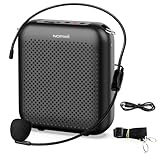
- Effective for Teaching - With a 10-watt output power,the portable voice amplifier with wired headset microphone make your voice louder and travel further, helping students listen more clearly and attentively. Its lightweight and portable design makes it a favorite among teachers, fitness instructors, tour guides, promotion events
- Loud and Clear Sound - 3-inch speakers plus a booster circuit makes the voice amplifier crystal clear sound with good sound quality, effectively saving the teacher's throat. Designed for educators, trusted by professionals. Teacher must haves
- Teach Without Ear-Piercing Feedback - The Voice Amplifier utilizes advanced frequency shifting technology to supress feedback effectively. To ensure optimal performance, maintain a distance of 20 cm between the microphone and the amplifier to avoid any feedback issues
- Week-Long Battery- 2000 mAh battery supports 12-15 hours continuous teaching, 4000 mAh battery supports 25-30 hours continuous teaching. Full-day outdoor events without recharge anxiety. USB-C rechargeable
- Simple and Practical, Teacher-Centric Design - Only 2 steps: 1.Turn on the amplifier; 2.Plug the microphone into the MIC port of the amplifier. Now, it's ready. Unlike buttons, the analog dial offers finer volume increments. Ultra-lightweight with clip-on belt strap – teach hands-free
Local execution also means that the recording, software environment, and computing resources are part of your setup. The cited sources do not specify a universal minimum hardware configuration, supported language list, or guaranteed output quality, so those should not be assumed from the architecture alone.
Independent reader supportYour contribution helps us test, update, and keep practical guides available for everyone.What does training the three models require?
Training from scratch is substantially more demanding than supplying a reference clip for inference. Jemine’s training guide says to have at least 500 GB of free space if datasets are deleted after use, and recommends 1 TB to be comfortable. Those are storage recommendations from the project guide, not a complete estimate of GPU time or a guarantee that a particular machine can finish training efficiently.
Quick wins for a faster PC:
Clear out junk files and repair common Windows errorsFree Scan →Scan for outdated or missing drivers - takes under a minuteDriver Scan →Best Value

- 【Small Size and Powerful Sound】The personal voice amplifier is mini in size and light in weight (size 3.6 x 2.8 x 1 inches and weight 0.4 lb), but with up to 8W output crystal sound and no noise. the sound of microphone speaker is loud enough to cover a large room of 25-100 people. The stable performance perfect for amplifying your voice and saving your throat. A best portable amplifier for teaching, trainer, singer, coacher, tour guide, shopping mall, presentation, outdoor speech and etc.
- 【Multifunctional Teacher Microphone】This microphone for classroom teachers supports MP3 audio playing: TF (Micro SD) card playing & USB flash drive playing. Portable microphone headset can repeat single tune, loop all music and switch songs. The portable microphone and speaker has 3.5mm jack,, can work as a wired speaker.
- 【2200mAh Rechargeable Voice Amplifier】Mini voice amplifier has a built-in a 2200mAh large lithium battery, that allows the portable speaker with microphone to take 4-6 hours to fully charge, but plays up to 20 hours of amplify time and up to 13 hours of music playtime.
- 【Comfortable and Portable Mic】①The head microphone is lightweight and adjustable. You can adjust the distance between the microphone and mouth with its flexible gooseneck. ②This microphone headset with speaker comes with an adjustable band that you can use it to tie around your waist or hang on your neck. ③The headset microphone for speaking has a clip on the back, you can clip on a belt or the pant waistband.
- 【Warm Tips and Guarantee】12 Months Warranty and lifetime after-sales customer services make your purchase absolutely risk-free. Please charge the classroom microphone for teachers before first time using, keep the voice microphone and mic for a distance to avoid the noise.
Datasets documented for the pipeline
| Model or stage | Documented datasets and materials |
|---|---|
| Encoder | LibriSpeech train-other-500; VoxCeleb1 Dev A–D plus metadata; and VoxCeleb2 Dev A–H |
| Synthesizer and vocoder | LibriSpeech train-clean-100 and train-clean-360, plus LibriSpeech alignments |
| Additional possible datasets | LibriTTS, VCTK, and M-AILABS |
The guide names these datasets as part of its training workflow. Availability, download size, and the work needed to prepare them are separate considerations; the storage recommendation reflects the guide’s warning that fully training all three models involves a lot of data.
Documented training order
- Prepare the encoder datasets and train the speaker encoder.
- Prepare synthesizer audio and speaker embeddings, then train the synthesizer.
- Prepare the vocoder data and train the vocoder.
The project’s training guide provides corresponding Python commands, but they are not reproduced here because the applicable commands can depend on the repository version and environment. Use the guide for the exact commands and prerequisites for the version you plan to run.
What SV2TTS does—and does not—establish
The key technical idea is the separation of speaker representation, text-to-acoustic-feature generation, and waveform synthesis. This lets the system condition speech generation on an unseen speaker’s embedding without retraining specifically for that speaker. It does not, by itself, establish that a generated voice will be indistinguishable from the reference, or that results will be equally strong across recording conditions, speakers, or languages.
Quick Recap
Product prices and availability are accurate as of the date/time indicated and are subject to change. Any price and availability information displayed on Amazon at the time of purchase will apply.
What’s actually slowing this PC down?
Pick the symptom - the matching free tool is one click away.

