
Greg Sadetsky has recreated the Minivac 601 as an interactive browser simulation: you can connect virtual components, follow the logic as it runs, hear simulated relay clicks and browse the machine’s original manuals. It offers a way to explore a rare 1961 educational computer without finding or powering fragile original hardware.
What was the Minivac 601?
The Minivac 601 was an educational digital-computer kit sold by Scientific Development Corporation in 1961. The Centre for Computing History records its original price as $85, and the company’s contemporary advertisement also offered it for $85, describing a 24-inch computer supplied with six instruction manuals. Centre for Computing History · Scientific Development Corporation advertisement
Rather than hiding computation in a silicon chip, the Minivac made its operations tangible. Electromechanical relays acted as logic switches and temporary storage; users could work with six binary switches, six indicator lights and a motorized dial for entering or displaying numbers. Centre for Computing History
How does Sadetsky’s browser simulator work?
The simulation brings the machine’s hands-on approach to a web page. Users can wire virtual components, run experiments, inspect original Minivac manuals and hear simulated relay sounds. Its creator, Greg Sadetsky, describes it as a working simulation in which “You can watch it think slowly enough to see every step.” Greg Sadetsky
#1 Best Overall

- This electronic sensor kit contains 48 pieces most popular and mainstream sensors and modules, allow you to do a lot of devices, robots and other interactive projects. This kit Not contains arduino controller board.
- Compatible with various micro-controllers and Raspberry Pi, such as mega 2560, r3 development board, pro micro, leonardo, etc. Note we only offer arduino instructions.
- We provide detailed projects for each sensor based on development board, including wiring method, test code, etc. Download the arduino tutorial from the wiki website.
- This is complete sensor kit with exquisite packaging. It's a good electronics kit for junior high and high school inventors, hackers, designers, and tinkerers of all levels.
- The tutorials show wiring for the Arduino and give example codes. All of this makes getting started with sensors quite easy. The professional team is ready to answer any questions.
The simulated electrical behavior is based on Willy McAllister’s Circuit Sandbox analysis. That makes the project more than a static display: it is designed to let visitors connect parts and observe how a relay-based circuit behaves. Circuit Sandbox
Minivac 601 hardware vs. the browser simulation
| What matters | Original Minivac 601 | Sadetsky’s simulation |
|---|---|---|
| Availability | Working machines are hard to find; surviving hardware can be mechanically worn. IEEE Spectrum | Available as an interactive browser project. Greg Sadetsky |
| Physicality and sound | Uses real electromechanical relays, switches, lamps and a motorized dial. Centre for Computing History | Offers virtual wiring and simulated relay sounds rather than physical moving parts. Greg Sadetsky |
| Setup and safety | Requires access to original hardware; the cited sources do not specify operating or safety requirements. | Runs in a browser, so no original machine needs to be located or powered. Greg Sadetsky |
| Seeing relay logic | Physical switches and indicators expose the machine’s electromechanical operation. Centre for Computing History | Lets users wire components and follow simulated operation step by step. Greg Sadetsky |
| Original manuals | The kit was advertised with six instruction manuals. Scientific Development Corporation advertisement | Lets visitors browse the original manuals online. Greg Sadetsky |
| Experimenting | Experiments require access to a physical unit, which is difficult to find in working condition. IEEE Spectrum | Allows virtual wiring and experiments without owning potentially fragile 1961 hardware. Greg Sadetsky |
How was Claude Shannon involved?
The 1961 Scientific Development Corporation advertisement credits the kit as “Created as a private project by Dr. Claude E. Shannon.” Scientific Development Corporation advertisement However, IEEE Spectrum has noted that the documentary record directly connecting Shannon to the marketed Minivac 601 design is incomplete. IEEE Spectrum It is accurate to call Shannon the credited or associated designer, while recognizing that the surviving historical record does not fully establish the extent of his role in the product as sold.
Rank #2
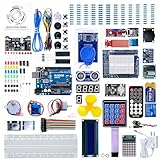
- 30+ Guided Electronics Projects: Start with LEDs and build toward LCD1602 displays, RFID access, motion detection, distance sensing, motor control and environmental monitoring for STEM learning, coding clubs, classrooms and hobby projects
- 200+ Components Across 63 Types: Includes an ELEGOO UNO R3 controller, LCD1602, RC522 RFID, RTC, HC-SR501 PIR sensor, ultrasonic sensor, DHT11, GY-521, MAX7219, keypad, joystick, relay, SG90 servo, stepper motor, breadboard and more
- Begin Without Soldering: Pre-soldered modules, a solderless breadboard, organized storage case and small-parts box reduce setup time and help beginners move from lesson to lesson while keeping LEDs, ICs, wires and sensors easy to find
- Learn, Modify and Create: Program the ELEGOO UNO R3 board with Arduino IDE using the included PDF tutorial and example code, then adjust sensor thresholds, timing, display text and motor behavior to turn guided lessons into original projects
- Flexible Power and Project Setup: Includes a 9 V, 1 A power supply, breadboard power module, 9 V battery and USB cable to support controller, breadboard and module experiments without sourcing basic setup accessories separately
Why try the simulation?
The Minivac’s educational appeal came from making digital logic something a learner could see and manipulate: switches set inputs, relays performed operations, and indicator lights or the dial showed results. The browser recreation carries that core idea forward while making it possible to experiment without handling scarce, aging hardware. It is not the same as feeling a physical relay move, but it provides an accessible way to explore the machine’s logic and consult its manuals.
Quick Recap
Best Value

- QUICKLY TEST RELAYS & LIVE CIRCUITS: Makes testing automotive relays and live circuits fast and easy without piercing wires
- 8 RELAY TEST JUMPERS INCLUDED: Includes eight jumpers designed to fit most popular automotive relays for convenient circuit testing
- EASY MULTIMETER CONNECTIONS: Test lead kit securely connects relay test jumpers to a multimeter for checking current or voltage
- TEST MORE RELAY CONFIGURATIONS: Terminal leads with switch, fuse and power options allow testing of many vehicle fuses and relays, including Volkswagen, BMW and other European applications
- EASY RELAY REMOVAL: Includes relay puller pliers for easily removing electrical relays and accessing vehicle circuits without damaging wires.
Rank #4
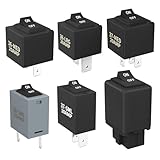
- Wide Compatibility & Effortless Control: This Relay tester kit is designed for seamless compatibility with a wide range of vehicles, including Audi, BMW, Volkswagen, GM, Chrysler, and more. Our relay bypass kit also replaces multiple relay models (9038, 9036, 9037) and provides direct control over fuel pumps, window motors, headlights, and other components
- Save Time & Diagnose Faster: This diagnostic tester is very convenient. Quickly identify electrical issues and save valuable time during repairs. Simply plug the relay tester into the fuel pump relay position to gain direct control over the circuit and pinpoint problems
- Reliable Performance & Built to Last: Crafted from high-quality materials, this relay tester is rigorously tested to meet or exceed OEM standards. Our relay bypass switch kit enjoy consistent operation with its 20 amp continuous and 30 amp surge current (12V) capacity, ensuring long-lasting performance
- Complete Kit for Versatile Applications: This 6-pack 9038 includes multiple Relay Testers, giving you ample options for a variety of repair needs and making it a valuable addition to any mechanic's tool box
- Component Included: Our product include relay bypass switch kit 9036-1(36-LRG 20AMP), 9036-2(36-MED 20AMP), 9036-3(36-SML 10AMP), 9037-1(37-LRG 20AMP), 9037-2(37-MED 20AMP), 9037-3(37-SML 10AMP)
Rank #3

- TURN CODE INTO REAL-WORLD RESULTS — Follow 22+ guided lessons to make LEDs blink, read temperature and distance, move servo and stepper motors, control an LCD and respond to joystick or IR input; ideal for a family weekend build, homeschool unit, coding club or STEM classroom
- MORE PROJECT VARIETY IN ONE ORGANIZED KIT — Includes the UNO R3 controller, LCD1602 with pre-soldered header, breadboard power module, ultrasonic and DHT11 sensors, joystick, IR receiver and remote, SG90 servo, stepper motor, relay, DC motor, fan blade, displays, LEDs, buttons, resistors and jumper wires
- START WITHOUT SOLDERING — Plug-in modules, a solderless breadboard and the pre-soldered LCD help beginners focus on wiring, code and testing; the illustrated component list makes it easier to find each part and move from one lesson to the next
- LEARN THE LOGIC, THEN CREATE YOUR OWN — Use Arduino IDE and the included example code to understand digital input and output, analog sensing, timing, motor control and display functions, then change thresholds, speeds and sequences for alarms, environmental monitors, reaction games and motion projects
- CLEAR SETUP SUPPORT FOR FIRST-TIME BUILDERS — Download the latest tutorial and code, select the UNO board and correct computer port, check component polarity and breadboard rows, and keep power-module input at 9V or below; younger learners should work with an experienced adult
Product prices and availability are accurate as of the date/time indicated and are subject to change. Any price and availability information displayed on Amazon at the time of purchase will apply.
Quick wins for a faster PC:
Repair Windows errors before they cause bigger problemsFix Now →Scan for outdated or missing drivers - takes under a minuteDriver Scan →
