
The most reliable way to integrate heterogeneous IoT data is a layered, hybrid architecture: connect devices and PLCs at the field layer, normalize and buffer data at an edge gateway, use OPC UA for industrial semantics and secure interoperability, use MQTT for lightweight publish/subscribe transport, then route curated telemetry to cloud storage, stream processing, dashboards, automation, and machine-learning systems.
ISO/IEC 30141:2024 provides reusable IoT architecture views and vocabulary. Use it to assign clear responsibilities to each layer rather than connecting every device directly to every application.
The layers of a dependable IoT data path
A layered design limits protocol sprawl, isolates failures, and lets you change analytics or cloud services without replacing field equipment. A practical path is field devices and PLCs → edge gateway → OPC UA or MQTT → broker and ingestion services → time-series or relational storage → applications and analytics.
Field devices and control systems
Sensors, actuators, drives, meters, robots, PLCs, and supervisory systems produce values in different formats and at different rates. Begin with an inventory that records each source, tag name, engineering unit, sampling interval, timestamp behavior, quality code, network location, owner, and safety impact.
The Tool Desk
Outbyte Driver Updater FREEFix the driver behind crashes, sound loss and screen glitchesFind Drivers →Outbyte PC Repair FREEClear out junk files and repair common Windows errorsFree Scan →#1 Best Overall

- Build a 37-Module Sensor Lab: Add motion, distance, light, sound, temperature, touch, display and control functions to compatible UNO, MEGA, Nano, ESP-32 or STM32 projects for prototyping, classroom experiments and maker builds
- Explore Input Sensors and Motion: Experiment with GY-521 motion sensing, PIR detection, ultrasonic ranging, temperature and humidity, DS18B20, flame, Hall, touch, light, sound, tilt, tracking and obstacle-avoidance modules
- Add Displays, Timing and Control: Use the LCD1602, DS1307 real-time clock, joystick, rotary encoder, relay, buzzers, RGB LEDs and infrared modules to build clocks, alarms, counters, status displays and automated projects
- Follow Guided Projects Materials: Use digital tutorial materials, datasheets, wiring diagrams and example code for compatible UNO R3, MEGA 2560 and Nano boards, then adjust thresholds, timing and logic to create custom experiments
- Module-Only Expansion Kit: Controller board, USB cable, breadboard and jumper wires are not included; use 6.5–9 V DC only with the included power module, verify pin requirements before wiring and keep the laser emitter away from eyes
Edge and gateway processing
An edge gateway terminates connections to machines, translates protocols, validates and enriches tags, filters noise, aggregates samples, buffers data during outages, and forwards only the telemetry that downstream systems need. Keeping protocol conversion close to a legacy source reduces the number of insecure or proprietary connections that cross the wider network.
Transport and middleware
Use OPC UA when consumers need industrial information models, relationships, quality metadata, and secure client/server or PubSub interoperability. Use MQTT when publishers and subscribers should be decoupled through a broker and when cloud, stream, or batch systems need lightweight transport. They can coexist in the same path.
Storage and applications
Time-series stores suit regularly sampled measurements; relational stores suit asset, production, and maintenance records. Stream processors can evaluate events immediately, while object storage supports historical analysis and model training. Dashboards, alerts, MES, maintenance systems, and machine-learning services should consume normalized data rather than raw device-specific payloads.
How to integrate heterogeneous IoT devices
1. Define a canonical asset and data model
Create stable identifiers for sites, lines, machines, sensors, and metrics. Preserve the original tag and source timestamp, but add a canonical name, unit, data type, quality state, location, and machine relationship. This lets a temperature value from a Modbus meter be compared with one from an OPC UA controller without losing provenance.
Rank #2

- 37 Sensors kit
- 37 Sensors Assortment Kit for Arduino MCU Education
- Touch sensor moduleHeartbeat detection module
- Infrared sensor receiver module
2. Connect each source through the narrowest practical interface
Prefer an existing supported interface on the equipment. A gateway can collect from PLC drivers, OPC UA servers, serial devices, or other industrial protocols and expose a controlled northbound interface. Do not give a cloud service direct access to every controller; place the gateway in an industrial network segment and allow only the required outbound flows.
3. Normalize at the edge
Convert units, timestamps, quality flags, and naming conventions before publication. Reject malformed values, mark stale readings, and attach gateway time when a device clock cannot be trusted. Keep raw payloads for troubleshooting when storage permits, but publish a documented canonical schema to applications.
4. Separate operational and analytical traffic
Control loops and safety functions should remain local to the controller or industrial control system. Send copies of telemetry to analytics platforms through a gateway or broker. Define sampling, deadband, batching, and event rules so high-frequency data does not overwhelm links or storage.
5. Test failure behavior
Disconnect the upstream link, restart the gateway, delay the broker, and send invalid values. Verify local buffering, ordering, duplicate handling, replay limits, alarm behavior, and recovery without affecting the process. Document which data may be dropped and which must be retained.
Rank #3

- Ultimate Sensor Kit for Arduino Beginners: The kit features the original Arduino Uno R4 Minima board, 30+ high-quality sensors and modules, and free video lessons co-created with educator Professor Joselito. With over 50 engaging projects (30 basic, 17 IoT, and 10 advanced fun projects), beginners aged 8+ can dive into the world of electronics and programming with ease. Certified RoHS compliant, it guarantees safety and quality for all learners, making it the perfect choice for both education and innovation
- Powered by the Arduino Uno R4 Minima: R4 Minima is a major upgrade from the Uno R3. With a 32-bit ARM Cortex-M4 processor, 256 KB Flash memory, and 48 MHz clock speed, it offers faster performance and greater memory. It also features higher-precision ADC (14-bit), a built-in DAC, CAN bus support, and a wider power input range (6-24V), making it more powerful and versatile for all users
- 30+ Sensors for Infinite Creativity: With 30+ high-quality sensors and modules, plus a battery for portable applications, this kit is ideal for IoT, environmental monitoring, and smart automation projects. It includes step-by-step tutorials, sample codes, and progressive online lessons, making learning seamless for beginners and advanced users alike. Fully compatible with other Arduino boards like Uno R3 and Nano, it offers endless customization and innovation opportunities
- Engaging Projects for Every Skill Level: Featuring 50+ projects (30 basic, 17 IoT, 10 advanced fun), this kit supports IoT platforms like Blynk and IFTTT, enabling smart automation and real-world applications. With Arduino C++ programming, step-by-step guidance, and hands-on coding exercises, it’s perfect for students, teachers, and engineers to learn, build, and innovate at any level
- Dedicated Support for Beginners: Alongside online resources and video tutorials, SunFounder provides technical support and troubleshooting forums to help beginners solve programming challenges with ease
OPC UA and MQTT: complementary technologies, not substitutes
OPC UA specifies an information model, message model, communication model, and conformance model. It is designed for secure, reliable communication from devices through enterprise and cloud systems. MQTT is a lightweight publish/subscribe transport: producers publish to topics, a broker distributes messages, and consumers can be added without reconfiguring producers. OPC UA PubSub also separates publishers and subscribers through message-oriented middleware.
| Decision factor | OPC UA | MQTT | Practical choice |
|---|---|---|---|
| Primary strength | Rich industrial semantics, discovery, relationships, and conformance | Lightweight brokered publish/subscribe transport | Use OPC UA for meaning; MQTT for distribution and decoupling |
| Typical topology | Client/server, with PubSub available | Publishers and subscribers connected through a broker | Gateway can expose OPC UA southbound and MQTT northbound |
| Payload meaning | Information models can describe assets and types | Topic and payload conventions must be designed by the implementer | Use a governed schema such as a site-wide canonical model |
| Industrial interoperability | Strong when products support the required companion specifications and profiles | Depends on payload schema and gateway adapters | Choose OPC UA where semantic interoperability is the requirement |
| Bandwidth and connection behavior | Supports industrial communication patterns; overhead depends on the chosen service and model | Designed for constrained links and asynchronous delivery | Use MQTT for large fleets and intermittently connected publishers |
| Cloud and stream integration | Often connected through an edge translator or broker | Direct fit for broker, stream, and cloud ingestion services | Bridge OPC UA data into MQTT at the edge |
| Security controls | Application authentication, authorization, encryption, and secure OPC UA modes | Authentication and authorization implemented by the broker and clients; protect sessions with TLS | Use device identities, least privilege, and TLS for MQTT links |
| Outage handling | Depends on client, server, and gateway buffering design | Session, delivery, and retained-message behavior depend on broker and client configuration | Specify queue, replay, ordering, and duplicate policies explicitly |
| Best fit | Machine, line, and plant interoperability | Telemetry fan-out, cloud ingestion, and event pipelines | A combined architecture usually avoids forcing one protocol to do both jobs |
The OPC Foundation describes an OPC UA server as a virtual interface between cloud applications and field sensors in an Industry 4.0 use case. That pattern is useful when the cloud should see a governed industrial model instead of vendor-specific device details.
Should IoT data be processed at the edge or in the cloud?
Put processing at the edge when the process is time-sensitive
RFC 9556 (Internet Research Task Force, 2024) identifies time sensitivity, data volume, connectivity cost, intermittent connectivity, privacy, and security as reasons centralized cloud processing may not satisfy an IoT application. Edge processing is appropriate for machine protection, local alarms, rapid quality checks, bandwidth-heavy filtering, and decisions that must continue during a WAN outage.
Use the cloud for fleet-wide context and intensive analysis
Central services are useful for cross-site dashboards, long-term retention, large-scale correlation, model training, centralized governance, and applications that do not require millisecond-level control. Cloud processing also simplifies access for distributed business systems, provided the data is curated and secured before it leaves the plant.
Rank #4

- Complete Project-Based Learning Path – Build 13 progressive projects (LED blink → button control → PIR motion sensor → music playback → motorized doors/windows → SK6812 RGB lighting → fan control → LCD display → gas alarm → temperature/humidity monitor → RFID door unlock → Morse code access → WiFi control → mobile APP remote control). Each project builds on the previous one, ensuring you understand both the electronics and the programming logic behind every smart home feature.
- Master Two Industry-Standard Languages – Learn to code in both Arduino C++ and MicroPython with 13 detailed tutorials for each language. Compare how the same hardware behaves under different programming approaches – a valuable skill for any aspiring engineer. Perfect for classrooms teaching multiple coding languages or self-learners who want flexibility.
- Build a Real WiFi-Controlled Smart Home – Assemble the wooden house structure and integrate sensors to create a functioning smart home system. Control lights, fans, door servos, and RGB lighting directly from your mobile APP (iOS/Android) . Experience how IoT works in real life – from manual control to automated responses based on temperature, humidity, motion, and gas detection.
- Comprehensive Online Wiki with No Guesswork – Our detailed online tutorials (also accessible via the packaging) include wiring diagrams, full code explanations, and step-by-step assembly guides for every project. Whether you're a complete beginner or a teacher preparing lessons, the structured content eliminates confusion and helps you succeed from project 1.
- Everything You Need to Get Started – (TIPS: Batteries are NOT Included)This kit includes the ESP32 development board, expansion board, wooden house parts, all sensors and modules (DHT11, PIR motion, gas sensor, RFID, SK6812 RGB, servo motors, fan, LCD1602, etc.), and connection cables. NOTE: 6x AA batteries are required (NOT Included). The kit is unassembled – you'll build it yourself following our online tutorials, making the learning experience truly hands-on.
Use a hybrid split for most industrial systems
Keep control, validation, filtering, buffering, and urgent rules at the gateway. Forward events and appropriately sampled telemetry to cloud brokers and storage. Store the original source timestamp and sequence information so delayed or replayed data can be distinguished from current measurements.
Connecting PLCs and legacy equipment securely
- Segment the network. Place controllers and gateways in controlled industrial zones. Permit only documented source, destination, port, and direction combinations.
- Use a gateway for insecure or proprietary sources. Terminate legacy protocols locally and expose a modern, authenticated interface northbound. Avoid extending an obsolete protocol across enterprise or public networks.
- Establish identities. Give each gateway, client, and important device a unique identity. Remove default credentials, rotate secrets, and grant read or write permissions only where required.
- Enable protocol security. Select secure OPC UA modes with certificate-based authentication and encryption where supported. Protect MQTT sessions with TLS; use HTTPS where an ingestion service requires it.
- Encrypt stored data. Protect gateway queues, broker persistence, backups, time-series databases, and object storage at rest, and restrict administrative access.
- Monitor and recover. Log authentication failures, certificate errors, configuration changes, protocol conversions, and unusual publish rates. Maintain certificate-expiry alerts, tested backups, and a documented gateway replacement procedure.
AWS industrial guidance specifically recommends secure OPC UA modes, MQTT over TLS, HTTPS, and protocol converters or gateways near insecure sources. Local MQTT brokers and edge gateways can keep operations running while upstream services are unavailable.
Independent reader supportYour contribution helps us test, update, and keep practical guides available for everyone.Turning telemetry into real-time insights
Model events before building dashboards
Define what constitutes a state change, threshold breach, missing heartbeat, bad-quality value, production cycle, or maintenance event. Include event time, ingestion time, asset identifier, value, unit, quality, sequence number, and correlation or batch identifier. This prevents dashboards from confusing a late message with a current condition.
Route data to the right processing path
- Real-time stream: alarms, anomaly rules, counts, and operational dashboards.
- Time-series storage: trends, energy analysis, condition monitoring, and high-resolution history.
- Relational storage: assets, work orders, recipes, production lots, and user-defined business relationships.
- Object or lake storage: raw archives, replay, cross-site analysis, and machine-learning features.
Make quality visible
Carry device quality, gateway validation status, clock source, and last-seen time into the analytical schema. A value with a bad quality flag should not silently drive an optimization model or close a maintenance alert.
Best Value
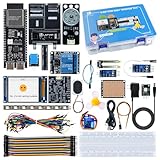
- 【High-Performance ESP32-S3 Microcontroller】 Equipped with revolutionary MCP protocol technology, the kit delivers a native AI voice control experience, perfectly adapting to various AIoT application scenarios, suitable for beginners, educators and makers.
- 【8 Versatile Hardware Modules Included】Comes with RGB LED module (full-color dimming, breathing light effect), WS2812 smart light strip (8 programmable LEDs), DHT11 sensor (real-time temperature and humidity monitoring), SG90 servo, DC fan, dual relay, raindrop and soil sensor, meeting diverse project needs.
- 【Zero-Threshold AIoT Control】Adopts innovative MCP protocol, allowing AI models to directly recognize hardware functions without complex programming. Pre-compiled firmware supports plug-and-play after burning, with an extensible architecture for secondary development.
- 【Multi-Scenario Application Coverage】Widely applicable to STEM education (learning IoT, AI interaction, embedded programming), smart home prototype verification, maker project development, and smart agriculture (soil monitoring, automatic irrigation systems).
- 【Comprehensive Learning & Technical Support】Provides an online document center with detailed quick-start guides and free professional technical support to answer questions and assist in problem-solving, helping users get started quickly.
Build feedback carefully
Read-only analytics should be the initial default. If an application writes setpoints or commands, enforce explicit authorization, range checks, approval workflows, audit logging, and a local safe-state strategy. Analytics services should not bypass the control system’s safety logic.
A reference implementation pattern
AWS industrial data-fabric guidance illustrates one concrete arrangement: PLC and industrial sources feed an Ignition or other edge layer through OPC UA and MQTT Sparkplug. The edge can publish selected data to services such as IoT Greengrass, IoT SiteWise, Kinesis, S3, Aurora, DynamoDB, Athena, Redshift, and SageMaker for local processing, streaming, storage, dashboards, and machine learning.
Microsoft IoT architecture guidance presents comparable choices around MQTT broker capability, Azure IoT Hub or Event Hubs, OPC UA reference solutions, and analytics integration. The OPC Foundation cloud reference architecture likewise shows edge translators, MQTT or Kafka, cloud MES, databases, dashboards, and data-space connectors as interoperating building blocks.
These are patterns, not mandatory product combinations. Select services according to latency, data residency, existing skills, identity systems, retention needs, and the operational burden your team can support.
Do these 3 things before closing this tab:
1Scan for outdated or missing drivers - takes under a minute2Clear out junk files and repair common Windows errors3Fix the driver behind crashes, sound loss and screen glitchesQuick Recap
Design review checklist
- Are every device, gateway, broker, storage system, and application assigned an owner?
- Is the canonical asset and telemetry schema versioned and documented?
- Can the gateway continue safe local operation during a cloud or WAN outage?
- Are timestamps, quality states, sequence numbers, units, and provenance preserved?
- Are OPC UA certificates, MQTT client identities, TLS settings, and permissions managed through a lifecycle?
- Are protocol conversion and legacy connections isolated from enterprise networks?
- Do buffering, replay, deduplication, ordering, and retention rules match business requirements?
- Can operators trace a dashboard value back to its device, gateway transformation, and original timestamp?
- Are write commands separated from read-only analytics and protected by independent authorization?
- Have you tested gateway failure, broker failure, bad data, clock drift, certificate expiry, and restored connectivity?
Product prices and availability are accurate as of the date/time indicated and are subject to change. Any price and availability information displayed on Amazon at the time of purchase will apply.

